Skip to content

For law firms · Google Ads

A Google Ads consultant for law firms that count qualified calls, not form fills.

I'm Conner Crowe, a Google Ads consultant for law firms. I fix what the account counts as a conversion, then rebuild the campaigns around the matters the firm wants more of. On Greenacre Law's account that cut spend in half and doubled qualified signups in 90 days. I'm based in Spokane, WA and work remotely, so your firm can be in any state. Where bar rules differ, like California's 2026 changes under SB 37, your counsel signs off on the copy.

Video · 1:03 · Sound on

Who I am and how I work

Read the transcript

I'm Conner Crowe. I help ecommerce and service businesses get more customers from Google, and from AI assistants like ChatGPT. I run the website, the ads and the tracking as one system. Everything between the click and the customer. I started in graphic design, then web design, then in-house marketing, then inside agencies, where I saw the model break. The senior sells the work, and a junior learns on your account. So I went independent. The person on the call does the work. Tracking gets fixed first. You get a written summary every Monday, month to month, and you own everything I build. Ten years, more than $15 million in managed ad spend. A furniture store I built went from $5K in its first month to $56K, five months later. When I'm not working, I'm outdoors. Out there, you never guess when you can measure. I run accounts the same way. Start with a free ads audit. I write it myself, and it's back within 24 hours.

01   The problem

Why most law-firm accounts
are quietly losing money.

Every legal-PPC agency sells on lead volume. Lead volume is the easiest number to count without integrating with the case management system. The problem is Smart Bidding now decides who sees the ad, and Smart Bidding optimizes against the conversion signal you give it. Give it "form-fill," it goes and finds you cheap form-fills. Half of which the intake team disqualifies in the first call.

The lead-quality gap between "the form was submitted" and "the retainer was signed" is where the budget goes. Generic agency optimization works on the first metric. Measuring the second from your intake log, and bidding on qualified calls in the meantime, is the work.

  • 27 of 28 Lead-gen accounts I manage that bid on calls
  • 46.1% Median share of ad calls under 60 seconds (20 accounts)
  • 40 of 47 Biddable call actions left on Google’s 60-second default
  • 5 of 28 Accounts bidding on a call action that counts 20 or 30 seconds

02   The diagnostic

What I see in a typical
law-firm Google Ads account.

Six patterns, in priority order. Most law-firm accounts I audit have several of these. The fixes are sequenced because some of them depend on the earlier ones being right.

  • Broad match without a negative-keyword list

    The Google rep keyword set. No negatives. Smart Bidding paying for DIY, template and job-seeker queries.

  • Conversion tracking on every form submit, including spam

    Required-field validation off. Bot fills, junk submissions, and double-submits all counted equally. Smart Bidding chases the cheapest junk because the algorithm cannot tell it apart from real intake.

  • Generic "Lawyer Near You" ad copy

    The same headline every competing firm runs. No filter for the case type the firm wants more of. The clicks come in, the wrong cases come in with them.

  • No call tracking with qualification scoring

    In legal, intake often starts with a phone call. Without call tracking wired into Ads, the callers who become clients stay invisible to the bidding.

  • No definition of a qualified call

    Intake knows which callers became consults. Google Ads doesn't, because nobody told it what a qualified call is. Smart Bidding keeps optimizing against form fills, spam included.

  • Geo-targeting set to the state, not the practice radius

    A single-office practice bidding across the whole state. Personal injury firms bidding across counties they cannot serve. Spend on clicks that will never sign.

03   The playbook

What I do specifically
for law firms.

Six moves in the first 90 days. Tracking first, because every other decision depends on the data being right. The full architecture lives in the Lead Quality Stack framework if you want to read the eight-layer reference. The questions firms ask most, from tracking signed cases to what an ad may say, are answered in the law firm marketing library. Start with how law firms track Google Ads leads to signed cases, what a law firm should pay per signed case, what lawyers can say in Google Ads, including California's SB 37 changes, and whether Local Services Ads are worth it for lawyers.

  1. 01

    Clean conversion tracking, first

    WhatConverts (or CallRail) installed with dynamic number insertion on every paid landing page. Form-submission events gated on required-field validation server-side, so junk submits do not fire. The primary conversion in Google Ads becomes "qualified intake," not raw form-fill.

  2. 02

    Case-type ad group segmentation

    One ad group per practice area the firm wants to grow, each on phrase and exact match. Broad match only in a separate testing campaign with tight budget caps.

  3. 03

    Ad copy that filters in the right cases

    Headlines naming the case types the firm wants more of. Headlines naming the case types the firm does not want. Cheap clicks from the wrong intent become expensive clicks from the right intent. The intake calendar fills with cases the partners can staff.

  4. 04

    Negative-keyword hygiene, weekly

    Negatives pulled from the search-terms report and the call transcripts every week, starting in the first 30 days. Junk queries that produced bad intake become permanent exclusions inside two weeks.

  5. 05

    Intake outcomes reconciled every month

    I don't import signed cases into Google Ads. The conversion stays a WhatConverts-qualified call or a booked consult, and once a month I reconcile it against your intake log, so the report shows which campaigns produced matters the partners took.

  6. 06

    The Lead Quality Stack as the operating diagram

    Eight layers: CRM, browser tags, server-side, GA4, call tracking, Google Ads, Meta (where it fits), intake reconciliation. The full architecture is published at /frameworks/lead-quality-stack. Every law-firm engagement is wired against that diagram.

The compounding effect

Run the six moves for a quarter and Smart Bidding has a qualified-call signal to optimize against. Lead volume often drops first, because spam and junk stop counting. CPL on an agency dashboard can go up while cost per qualified lead falls. The two aren't the same number.

04   The proof point

Greenacre Law.
Half the spend, twice the signups.

I inherited a Google Ads account spending five figures a month on broad-match keywords with broken conversion tracking. Form submits counted as conversions regardless of spam, bot traffic, or whether the form passed validation. The partners said the leads were unusable.

The 90-day rebuild: WhatConverts-qualified calls as the conversion, case-type ad groups, ad copy that filtered in the cases the firm wanted, and 300+ negative keywords pulled from search-terms data. Part two scored 236 recorded calls and priced the qualified ones by matter type with the firm's own numbers. I also built the firm's 224-page bilingual site.

  • 50%

    Monthly ad spend reduction

  • 2×

    Monthly qualified signups

  • 60%+

    Cost per qualified lead reduction

  • 90 d

    To stable result

05   Engagement levels

Three ways in.
Most law firms start with tracking.

Most firms start with the free audit. Prices below are the published ones; the project quote comes from what the audit finds.

One-time projects

Fixed price, quoted from the free audit. Fixing tracking is typically $2,500: a rebuild of conversion tracking and lead-quality plumbing for a law-firm account. Call tracking, form-validation gating, intake reconciliation and call scoring.

$2,500 to $20,000 / project

Fixed price, quoted after the audit

  • → Full audit of tracking, call routing, and case management flow
  • → WhatConverts or CallRail wired into Ads + GA4
  • → Form quality scoring rubric authored to your practice areas
  • → Monthly intake reconciliation against Clio, MyCase or PracticePanther
  • → A service-business site, up to about 40 pages, from $10,000
Start with a free ads audit

Fractional Marketing Lead

Every add-on in, capped at $8,500 a month, month-to-month: strategy, channels, tracking, landing pages per practice area and the Monday report. The same $2,500 channel price plus $1,500 per add-on, with nothing above the cap.

$8,500 / month

Ongoing · month-to-month

  • → Every monthly add-on, capped at $8,500/mo
  • → Landing page builds for each practice area
  • → Marketing strategy authored quarterly
  • → Direct slack channel and monthly leadership review
  • → Quarterly board-ready strategy doc
Engage the full program

What the work looks like

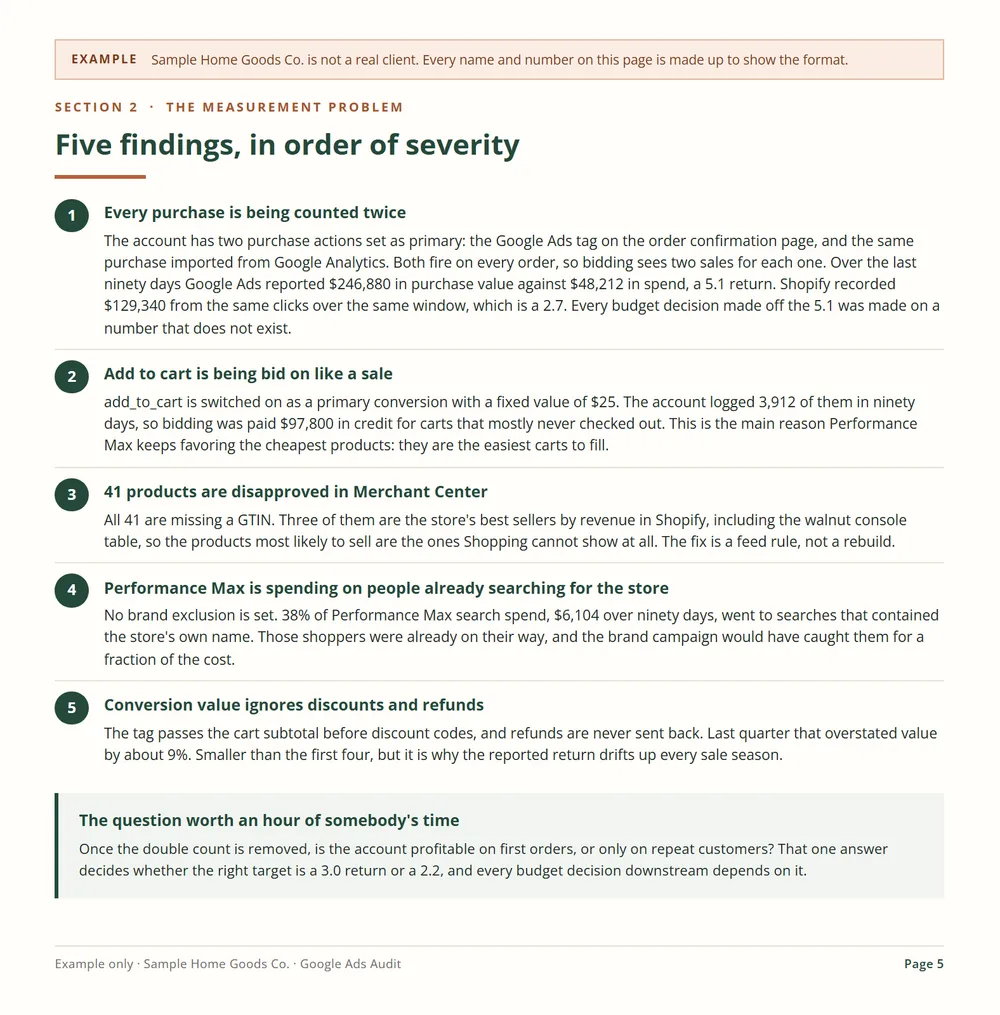
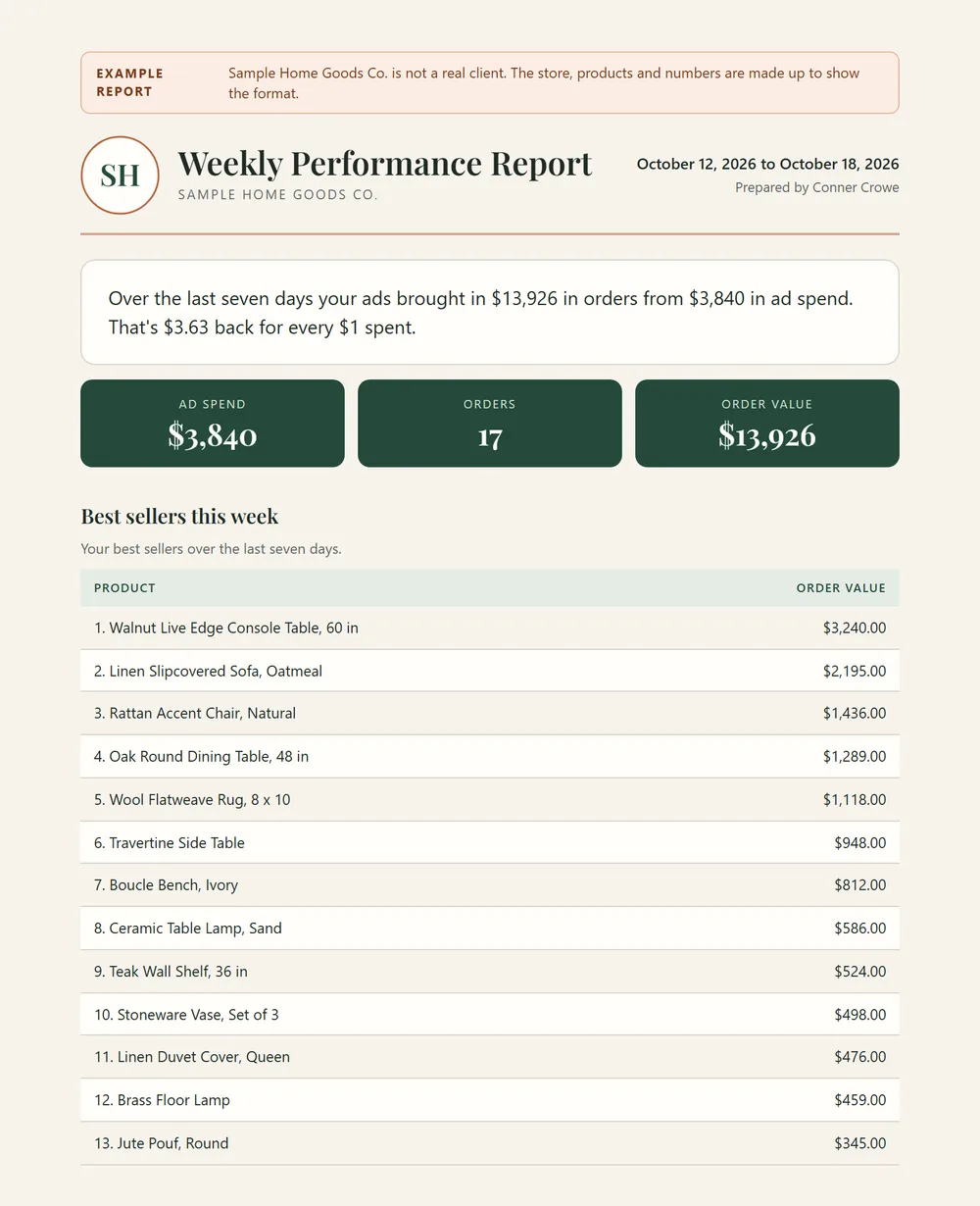
The exact templates I send clients, filled in for a made-up sample store, in the order an engagement runs. Pick a step, or let it play.

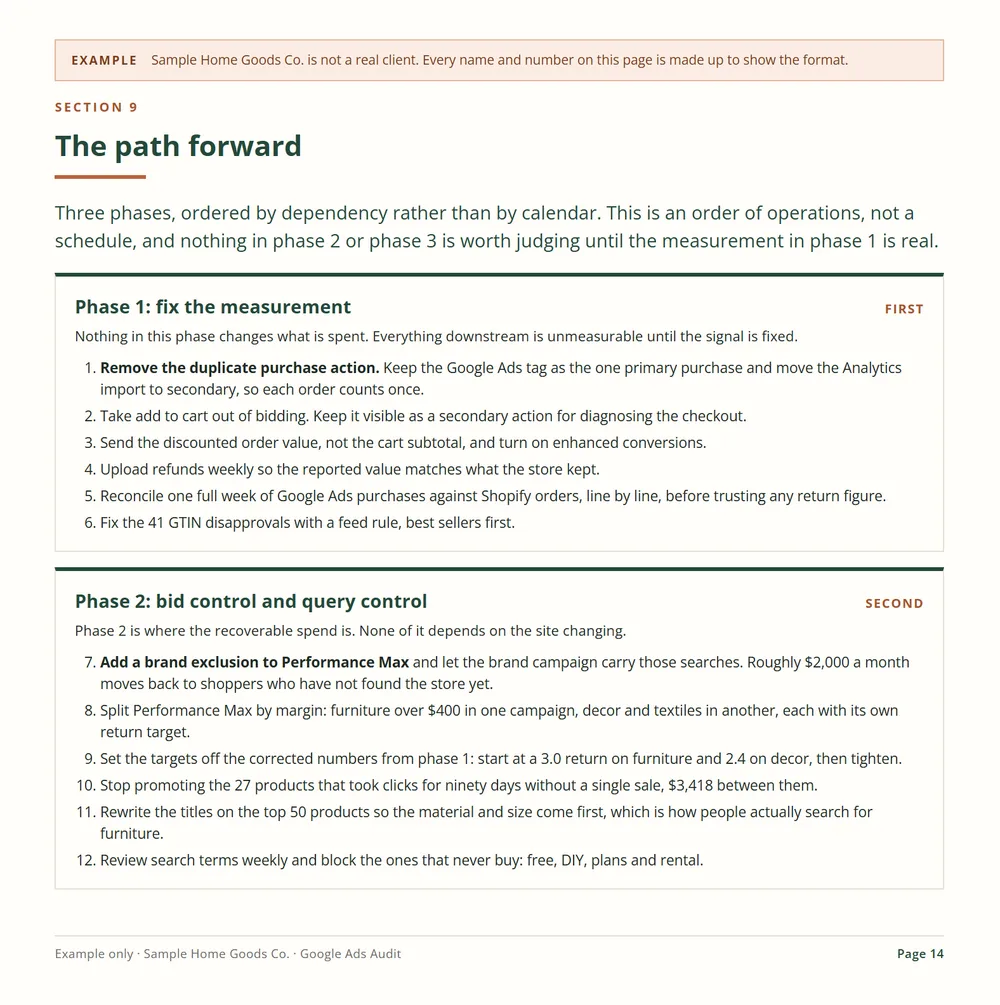
Example audit page, marked as sample data, titled The path forward. Phase one, fix the measurement: remove the duplicate purchase action, take add to cart out of bidding, send discounted order value. Phase two, bid control and query control: add a brand exclusion to Performance Max, split it by margin, stop promoting 27 products with clicks and no sales. (opens a larger view)

Week 1

The plan, in writing

  • Phases ordered by dependency, not by calendar. Nothing in phase two gets judged until the measurement in phase one is real.
  • Written down, so you can push back before a single setting changes.

Example page on the real audit template. The store and every number are made up.

06   Practice areas

Where this fits best.
Each area has a signature.

The same discipline applies across practice areas; the signal looks different in each.

  • Personal injury

    High case value, long sales cycle. Lead-quality engineering matters most here because junk leads burn months of intake time. Smart Bidding tuned to qualified intake calls, not vehicle-accident form fills.

  • Family law

    Emotional intent, short qualification window. Call tracking is non-negotiable. Most family-law leads arrive by phone and the close happens in the first call.

  • Estate planning

    Matter-type segmentation is the lever. Wills, trusts, and probate price differently and close differently, and ad copy should filter out the DIY searches.

  • Business law

    B2B intent, higher case value, longer pipeline. Qualified-call conversions and a monthly intake reconciliation matter most here, because the close can come months after the click.

  • Immigration

    Visa-type segmentation shapes everything. Family, employment, asylum, and removal cases price and close differently. Ad copy should filter by visa type.

  • Employment law

    Plaintiff vs. defense changes the entire account. Plaintiff-side runs on volume and case-type filtering. Defense-side runs on geographic and industry targeting. The two need different playbooks.

07   Fit

Who this is for.
Who it isn't.

Straight read on whether the engagement is going to land. If you fit the left column, book a call. If you fit the right column, the unit economics will not pay back the work and I will tell you so on the call.

Who this is for

  • → $10K to $50K per month in Google Ads spend
  • → Partner or marketing director who can authorize CRM and call-tracking integrations
  • → Willing to share your intake log so qualified calls can be reconciled against the matters you took
  • → Average case value above $2,000 (anything lower, the unit economics on paid rarely work)

Who this isn't for

  • × Under $5K per month in Google Ads spend
  • × Looking for an account manager who emails screenshots on Fridays
  • × Reporting that lives at lead volume, not qualified intake
  • × Unwilling to share intake outcomes, even monthly

AI answers

What ChatGPT says
about your firm.

More people now ask ChatGPT or Google's AI which lawyer to call before they search. The answer usually names a short list of firms, and it is assembled from your Google listing, directories like Justia and Avvo, and your own site. When those sources disagree, the assistant repeats whichever one it trusts, and nothing in your reporting shows you which.

The AI Answer Snapshot is free: 10 questions your clients ask, put to 3 AI engines, with a ranked fix list within 48 hours. The full audit, 30 questions to 5 engines with 3 runs each, comes first in any paid engagement. California firms get it as a custom engagement, with your own counsel signing off on every public change it leads to.

Request my AI Answer Snapshot→

Ready to talk

Stop paying for leads
that never sign.

Start with a free ads audit: read-only access, a 5 to 7 page written audit in 24 hours, no call. If you'd rather talk first, bring the Google Ads account and the close rate by practice area to a 30-minute call, and I'll tell you where the lead-quality leak is and what to fix first.

Want the eight-layer architecture first? Read the Lead Quality Stack. It is the reference doc behind every law-firm engagement.

Or email hi@connercrowe.com.

FAQ

Before you ask.

Why do my Google Ads leads never turn into signed cases?

Because the account counts every form submit as a conversion, spam included, so Smart Bidding finds more of whatever produces form submits. I fix it upstream: a WhatConverts-qualified call or booked consult becomes the only primary conversion, form spam stops counting, and the campaigns get rebuilt around the matters you want.

How do you stop spam and unqualified intake forms inflating conversions?

Negative-keyword hygiene weekly, ad copy written to filter in the case types you want rather than attract everyone, and call tracking with qualification scoring so a call is judged on what it was, not that it happened. Broad match without a maintained negative list is the single most common cause of the problem.

Can Google Ads be told which cases closed?

It can, through offline conversion imports, but I don't build law-firm accounts on it. The conversion is a WhatConverts-qualified call or a booked consult, and I reconcile it against the firm's intake log each month, which keeps matter detail out of the ad platform.

Do I need a Google Ads consultant who specializes in law firms?

Not a law-only shop, but someone who has run a law-firm account and knows the two things that differ. Bar advertising rules limit what the ads can say, so copy needs a person who flags specialist claims and past results for your counsel. And the conversion has to be a qualified call or a booked consult, because a form fill in legal is often spam or the wrong matter. The rest is the same account work any good Google Ads manager does. Ask a candidate how they'd define a qualified call for your firm. If the answer is "a form submit", keep looking.

Should my campaigns be split by practice area?

Almost always. Case-type ad group segmentation lets the ad copy, the landing experience and the bids match the intent behind each search. A single campaign covering every practice area averages everything together and hides which case types are paying for themselves.

What does it cost?

Every audit is free. One-time projects run $2,500 to $20,000, at a fixed price quoted from the audit before work starts. Monthly runs $2,500 to $8,500 a month, month-to-month: $2,500 for one ad channel and $1,500 for each add-on. At $8,500 it is the Fractional Marketing Lead seat. Ad spend is never marked up. I work with the firm directly, not through a marketing coordinator, so the number of firms I can take at once is limited.

Is the audit free, and what access do you need?

Yes, at any spend level. Read-only access, a 5 to 7 page written audit in 24 hours, no call.

Do you work with law firms outside Washington?

Yes. I’m in Spokane and work remotely with firms in any state. Bar advertising rules differ by state, so your counsel approves the copy.

Do you write ad copy that complies with bar rules?

I write it to the rules I can cite and flag anything that needs a lawyer’s read, like specialist claims or past results. Sign-off stays with your counsel.

Do you manage Local Services Ads?

Not for a law firm right now. I can track LSA calls through to signed cases for the firm’s own reporting.