Skip to content

Google Ads for home-services businesses

Your account counts form-fills. I count booked jobs.

Most home-services accounts optimize for raw lead volume and ignore Local Services Ads quality, call tracking, and which leads became paying jobs. I make a WhatConverts-qualified call or a booked appointment the conversion in Google Ads, so Smart Bidding learns which clicks produce work, and the phone counts as a first-class conversion.

Video · 1:03 · Sound on

Who I am and how I work

Read the transcript

I'm Conner Crowe. I help ecommerce and service businesses get more customers from Google, and from AI assistants like ChatGPT. I run the website, the ads and the tracking as one system. Everything between the click and the customer. I started in graphic design, then web design, then in-house marketing, then inside agencies, where I saw the model break. The senior sells the work, and a junior learns on your account. So I went independent. The person on the call does the work. Tracking gets fixed first. You get a written summary every Monday, month to month, and you own everything I build. Ten years, more than $15 million in managed ad spend. A furniture store I built went from $5K in its first month to $56K, five months later. When I'm not working, I'm outdoors. Out there, you never guess when you can measure. I run accounts the same way. Start with a free ads audit. I write it myself, and it's back within 24 hours.

01   The problem

Why most home-services accounts
are quietly losing money.

Here is what happens in most home-services accounts. The form on the website fires a conversion every time someone hits submit. Google sees a steady stream of conversions, so it bids harder on the keywords producing them. The dashboard looks healthy. Then you look at the calendar and the trucks are not full. The leads were tire-kickers, out-of-area, or price shoppers who never booked. Bad data leads to bad bids. Bad bids lead to wasted spend.

Two things make this worse in the trades. First, most of your leads call instead of filling out a form, and an account without call tracking is optimizing on the smaller half of your lead flow. Second, what pays your crew is the booked job, and almost no account counts the closest signal to it: a qualified call or a booked appointment. So Smart Bidding chases form-fills and missed calls while the keywords that produce real jobs sit underfunded.

  • $163 median cost per lead, Q3 2026 (N = 9)
  • 2 of 11 accounts with tracking too broken to benchmark (N = 11)
  • Most home-services leads I see arrive by phone, not form
  • 1 conversion that matters: a qualified call or booked appointment

02   The diagnostic

What I see in a typical
home-services account.

Six patterns, in priority order. Most accounts I audit have several of these. The fixes are sequenced, because some depend on the earlier ones being right.

  • Calls invisible to Ads

    Most home-services leads come by phone. Without dynamic number insertion and call tracking, those calls never reach Google. Smart Bidding optimizes on form-fills alone and starves the keywords that ring the phone.

  • Raw form-fills as the goal

    The account counts every submit as a win, including out-of-area requests, warranty calls, and people who wanted a different trade. Google bids up whatever produces the most submits, qualified or not.

  • Local Services Ads left on autopilot

    LSAs sit above Search and bill per lead, but most accounts never dispute bad leads, never tune the job types, and never reconcile LSA leads against booked jobs. You pay for leads that were never yours to win.

  • No booked-appointment conversion

    You know which leads booked. Google doesn't, because the account counts the form fill or the call timer instead. Until a booked appointment or a qualified call is the conversion, the signal that separates a real customer from a tire-kicker never reaches the algorithm.

  • Statewide or metro-wide geo

    Your crew drives a service radius, not a state. Broad geo-targeting spends on clicks from addresses you will not drive to, and on zips where your close rate is poor.

  • GA4 mistaken for ad grading

    GA4 shows behavior, not which campaign produced a booked job. Accounts that grade ads on GA4 events optimize toward pageviews and bounce rate instead of revenue, and the trends mislead every bid.

03   The playbook

What I do specifically
for home services.

Six moves in the first 90 days. Tracking first, because every other decision depends on the data being right. The full architecture lives in the Lead Quality Stack framework, and the question-by-question diagnosis is the Lead Quality library.

  1. 01

    Fix the tracking before touching a bid

    I start with the CLOSE Audit: CRM as source of truth, Lead-source capture, Offline imports, Signal swap to a qualified lead, Enhanced Conversions. Every record gets a gclid. Stages get timestamped. I confirm the data is clean before I change a single bid, because bad data leads to bad bids.

  2. 02

    Make the phone a first-class conversion

    I install call tracking with dynamic number insertion (WhatConverts or CallRail) so every call is attributed to the keyword and campaign that produced it. For most trades this surfaces more leads than the forms ever did, and Google finally sees your real demand.

  3. 03

    Tune Local Services Ads, not just Search

    LSAs run alongside Search as a separate lever. I set the job types and service area, dispute bad leads so you are credited, and reconcile LSA leads against booked jobs so the channel is measured on work won, not raw lead count.

  4. 04

    Swap the conversion to a qualified lead

    I move the account off raw form-fills to one primary conversion: a qualified lead. A misdial, a warranty call, and an out-of-area request stop counting as wins. Enhanced Conversions for Leads tighten the match so Smart Bidding learns from clean signal.

  5. 05

    Add booked jobs from the CRM, if it holds them

    Once the booked appointment is counting cleanly, a CRM that records paid jobs can send them back to Google Ads as an offline import. It's an optional layer, not the starting point, and it only helps when the CRM keeps the click ID with the job.

  6. 06

    Run Search first, tighten geo, add Meta where it fits

    Search and LSAs carry high-intent demand, so they come first. I target the service radius and zips you drive, set tCPA against qualified leads, and layer Meta only where it earns its place. No statewide spray, no channel for the sake of a channel.

The compounding effect

Each move feeds the next. Clean tracking makes the phone visible. A visible phone plus a qualified-lead conversion gives Smart Bidding honest signal. Where the CRM records paid jobs, an optional import adds revenue grading on top. Once the conversion is honest, the algorithm gets smarter every week on its own, because it's finally learning from qualified calls and booked appointments instead of form submits. That is the difference between an account that plateaus and one that compounds.

04   The proof

Real accounts in the trades.
One documented transformation.

Let me be straight about the proof, because it matters. I am not going to invent a home-services result or borrow a client's numbers to sell you. So here are two real things instead, and I will tell you exactly what each one is.

What I run in the trades right now

Across the home-services accounts I run, Q3 2026 cost per lead ran from $98 (septic) to $480 (roofing) across the eight trades I show, one account each (N = 8). The median across the nine with clean tracking was $163 (N = 9). Job value is different in every trade, so cost per lead is too.

Here’s a real one, anonymized. One of those accounts, an HVAC shop, reported a 67% conversion rate in my July 2026 benchmark, because taps on its phone number were counting as calls. That’s the loose lead counting this page is about. With most of those taps taken out, it reported 6.3% in Q3 2026 (N = 1), and its dashboard cost per lead went up. The number on the dashboard means nothing until it counts a qualified call or a booked appointment instead of a tap.

  • 11

    Home-services accounts, Q3 2026 (N = 11)

  • $163

    Median cost per lead, Q3 2026 (N = 9)

  • 2

    Of 11 with tracking too broken to benchmark (N = 11)

The full Q3 2026 breakdown, cost per lead by trade with the N on every row, is in my home-services benchmark report.

The documented fix

A fence contractor's account said website leads were zero. They weren't. The only website conversion had died when someone renamed a form button from Send to Submit, so Smart Bidding kept steering budget toward phone taps and away from form leads. I rewired it to the form's own success event, turned off self-applying recommendations and cleaned the keywords.

The conversion came back and the waste stopped. Where your CRM records booked jobs, an offline import can add them later. The default conversion stays a WhatConverts-qualified call or a booked appointment.

  • <1%

    Rank-lost impression share after cleanup, from 27 to 48%

  • 86%

    Conversions from two protected keyword themes

  • 42

    Conversions in the 90-day view

04   Engagement levels

Three ways in.
Most shops start with tracking.

Every account starts with the free audit. The prices below are the published ones; the project quote comes from what the audit finds.

One-time projects

Fixed price, quoted from the free audit. Fixing tracking is typically $2,500. The diagnosis and the plumbing: I run the CLOSE Audit, wire call tracking, make a qualified call or a booked appointment the conversion, and hand you an account that finally measures real work.

$2,500 to $20,000 / project

Fixed price, quoted after the audit

  • →The CLOSE Audit of your account and CRM
  • →Call tracking with dynamic number insertion installed
  • →Server-side GTM container and clean form validation
  • →One primary conversion swapped to qualified lead
  • →Enhanced Conversions for Leads configured
  • →Optional booked-job import, where your CRM records jobs with the click ID
  • →A service-business site, up to about 40 pages, from $10,000
Start with a free ads audit

Fractional Marketing Lead

The whole stack. Search, LSAs, Meta where it fits, and the qualified-call conversion maintained as your seasons and service area shift. For shops scaling across trades or markets.

$8,500 / month

Ongoing · month-to-month

  • →Every monthly add-on, capped at $8,500/mo
  • →Meta campaigns where they earn their place
  • →Seasonal and emergency-vs-scheduled budget planning
  • →Multi-location or multi-trade account structure
  • →Optional CRM job import kept current as the CRM evolves
  • →Direct access. Same person on the call as on the keyboard.
Build the program

What the work looks like

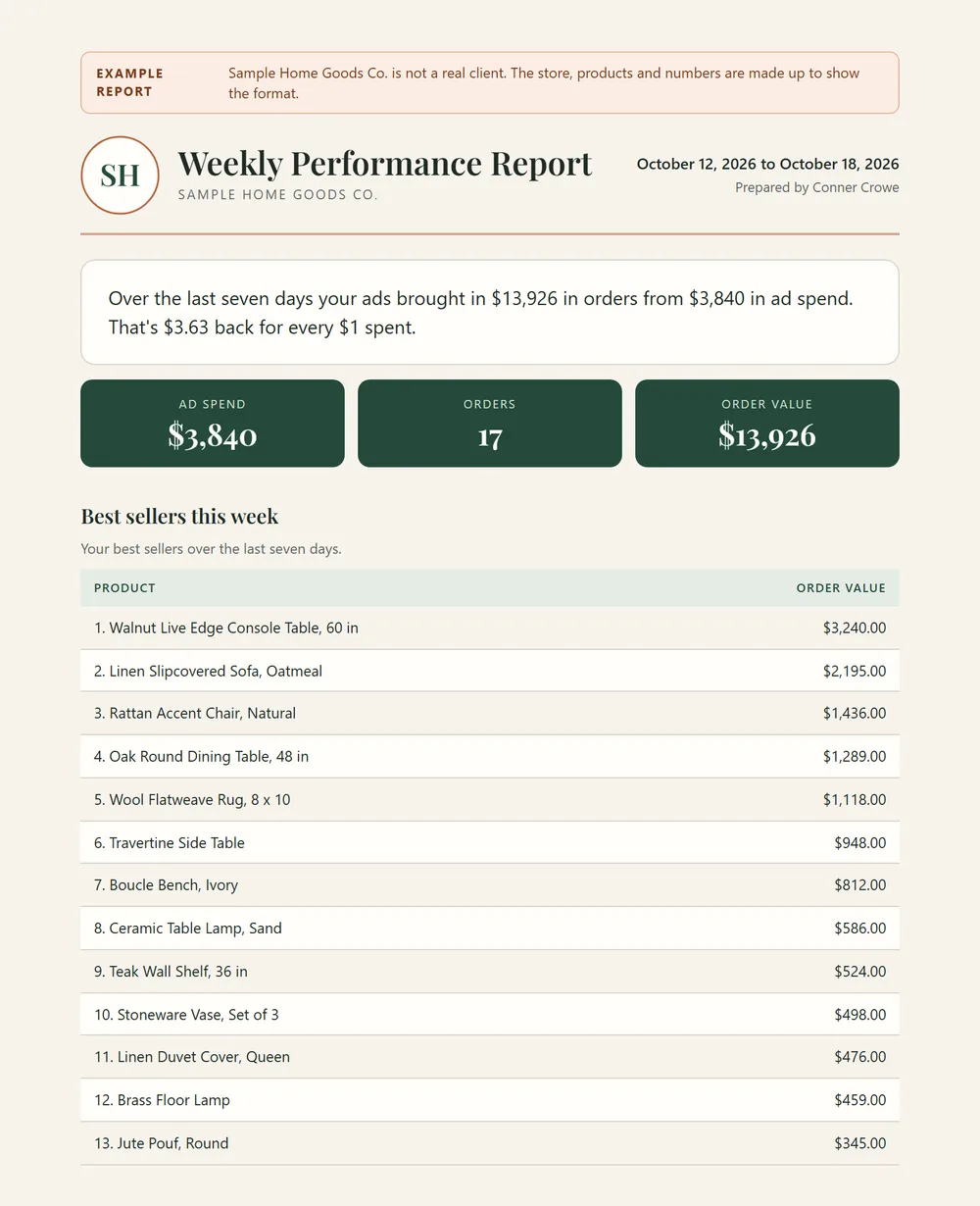
The exact templates I send clients, filled in for a made-up sample store, in the order an engagement runs. Pick a step, or let it play.

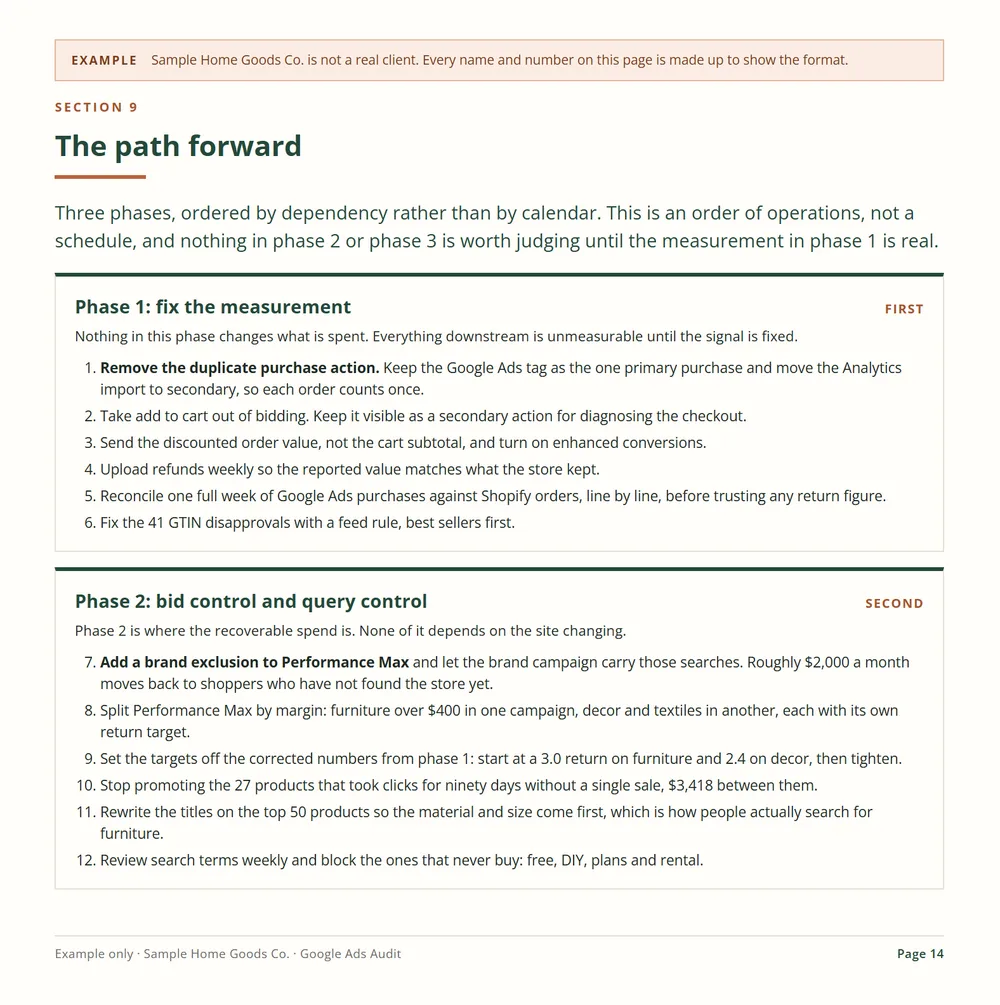
Example audit page, marked as sample data, titled The path forward. Phase one, fix the measurement: remove the duplicate purchase action, take add to cart out of bidding, send discounted order value. Phase two, bid control and query control: add a brand exclusion to Performance Max, split it by margin, stop promoting 27 products with clicks and no sales. (opens a larger view)

Week 1

The plan, in writing

  • Phases ordered by dependency, not by calendar. Nothing in phase two gets judged until the measurement in phase one is real.
  • Written down, so you can push back before a single setting changes.

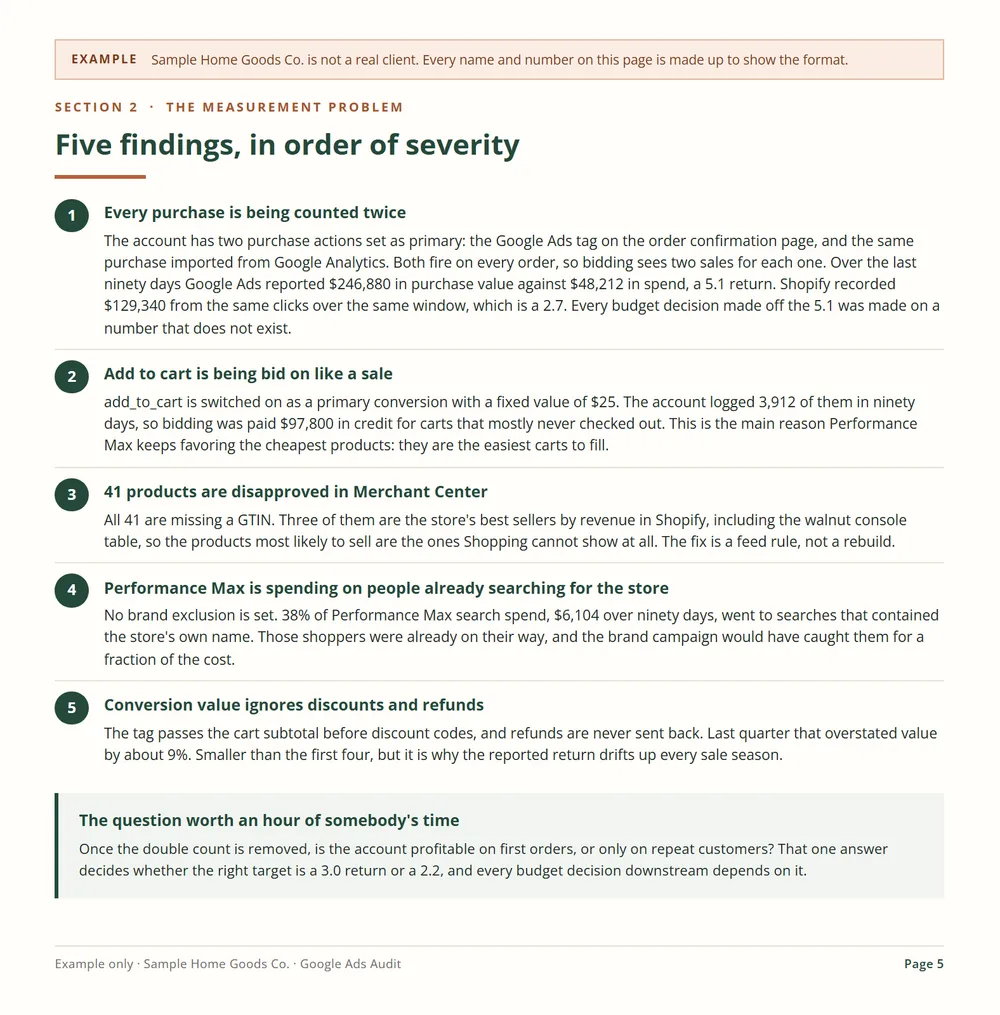
Example page on the real audit template. The store and every number are made up.

05   Trades

Where this fits best.
Each trade has a signature.

The lead-quality engineering is the same discipline across the trades. What a booked job looks like, and how the demand behaves, is different in each one. Six where I have run the playbook.

  • HVAC

    Emergency no-cool and no-heat calls spike with the weather and convert by phone. I weight call tracking and LSAs heavily, then separate emergency intent from scheduled installs so each gets its own budget and bid.

  • Plumbing

    Burst pipes and clogged drains are now-or-never phone calls. Call qualification matters most here, because a flood of urgent calls hides a wide spread in lead quality. Google needs to know which calls were qualified, not just which ones rang.

  • Electrical

    Panel upgrades and rewires carry high job values that raw form-fills never reflect. Counting qualified calls and booked appointments instead of every submit lets Smart Bidding chase the clicks that ask for the bigger jobs, not just the most leads.

  • Roofing

    Long sales cycles and storm-driven demand make form-fills a poor signal. I count the qualified call or the booked inspection, not the form-fill, so seasonal spikes get funded on lead quality, not click volume, and out-of-area leads stop draining budget.

  • Fencing and decks

    Quote-heavy and seasonal, with a gap between the estimate request and the booked install. I count the booked estimate appointment as the conversion, so the account learns which keywords produce real quote requests, not tire-kickers.

  • Garage doors and remodeling

    Mixed urgent repairs and planned projects in one account. I split the conversion actions so a same-day spring repair and a six-week remodel are measured on their own terms, not averaged into one misleading number.

06   Fit

Who this is for.
Who it isn't.

Straight read on whether the engagement is going to land. If you fit the left column, book a call. If you fit the right column, the unit economics will not pay back the work, and I will tell you so on the call.

Who this is for

  • →You spend $5K to $100K a month on Google Ads and the trucks still are not full
  • →Most of your leads call, and you suspect Google is not counting them
  • →Your CRM knows which jobs closed, but Google never finds out
  • →You want LSAs and Search managed by one person who reads the call data

Who this isn't for

  • ×You want a thousand cheap leads and do not care how many become jobs
  • ×You measure success by form-fills on a dashboard and want to keep it that way
  • ×You won't allow call tracking on the site, so the phone stays invisible
  • ×You are looking for the lowest-cost vendor, not the best-measured account

Ready to talk

Stop bidding on form-fills.
Start bidding on qualified calls.

I'll run the CLOSE Audit on your account, show you where the spend is leaking, and tell you honestly whether a qualified-call conversion will move the number. No agency layers, no account manager relaying messages. Same person on the call as on the keyboard. If it's a fit, the tracking fix comes first and I build from there.

Want the eight-layer architecture first? Read the Lead Quality Stack, or work the Lead Quality library question by question.

Or email hi@connercrowe.com.

FAQ

Before you ask.

Why do my Google Ads leads never turn into booked jobs?

Because the account is optimizing for the wrong event. Most home-services accounts count every raw form-fill as a conversion, so Smart Bidding learns to find people who fill in forms rather than people who book work. Calls are often invisible to Ads entirely. Until a qualified call or a booked appointment is the conversion, the algorithm is being trained on the wrong outcome.

Should I run Local Services Ads or Google Ads?

Both, and they are not interchangeable. Local Services Ads sit above Search and are usually left on autopilot, which is where the waste hides. Search gives you control over the terms you appear for. I run Search first, tighten the geo, then treat LSAs as a managed channel rather than a set-and-forget one.

How do I get phone calls counted as conversions?

Call tracking wired into the account so a call becomes a first-class conversion instead of an untracked outcome. For most home-services businesses the phone is the main way work arrives, so an account that cannot see calls is grading itself on a fraction of its own results.

What do you need from me before this can work?

Read-only access to the ad account for the free audit. To fix it, permission to put call tracking on the site, so a WhatConverts-qualified call or a booked appointment becomes the conversion. If your CRM also records paid jobs with the click ID, I can import those later as an optional layer. It isn't required to start.

What does it cost?

Three ways in. Every audit is free. One-time projects run $2,500 to $20,000, at a fixed price quoted from the audit before work starts. Monthly runs $2,500 to $8,500 a month, month-to-month: $2,500 for one ad channel and $1,500 for each add-on. At $8,500 it is the Fractional Marketing Lead seat. Ad spend is never marked up. Several locations are quoted separately. If none of that fits the size of your business, say so on the call and I will tell you.