Agency
An account manager filters every decision
In-house
You write it between fires
With me
I write the program. You sign off.
47.66° N 117.43° W Summit · Profitable Growth
More buyers from Google and AI assistants like ChatGPT. I run the campaigns, catalog and tracking as one system, from ad click through checkout. Plus a built-in lifestyle photoshoot pipeline, so new SKUs get scenes in days, not weeks.
The deep specialty inside the full ecommerce practice. Selling furniture? See Google Ads for Shopify furniture brands.
Video · 1:03 · Sound on
Who I am and how I work
I'm Conner Crowe. I help ecommerce and service businesses get more customers from Google, and from AI assistants like ChatGPT. I run the website, the ads and the tracking as one system. Everything between the click and the customer. I started in graphic design, then web design, then in-house marketing, then inside agencies, where I saw the model break. The senior sells the work, and a junior learns on your account. So I went independent. The person on the call does the work. Tracking gets fixed first. You get a written summary every Monday, month to month, and you own everything I build. Ten years, more than $15 million in managed ad spend. A furniture store I built went from $5K in its first month to $56K, five months later. When I'm not working, I'm outdoors. Out there, you never guess when you can measure. I run accounts the same way. Start with a free ads audit. I write it myself, and it's back within 24 hours.
Running Google or Meta ads? Get a free ads audit instead.






01 The math
Studio photography is billed per SKU and booked weeks out, so new SKUs sit in the warehouse before they reach a feed. Meta catalog ads underperform because half the inventory ships with bare-product imagery. Google Shopping quietly suppresses the rest. Meanwhile the agency you hired has a junior on your account learning Google Ads on your spend.

02 The full program
What an agency splits across four juniors and a project manager, I run as one program. The lifestyle photoshoot is included. The work is the marketing strategy and the campaigns that imagery feeds.
I write the plan for positioning, channel budgets, and what to test next. I set the monthly targets for the catalog and campaigns, then review them with you.
Search, Shopping, PMax. Account structure, feed engineering, exclusions, intent themes. A decade and $15M+ managed on these keys.
Catalog ads, DCA, prospecting + retention split. Pixel and CAPI repair. Creative testing on the new imagery.
The studio shoot, run inside the engagement. Brand constitution, a 99% fidelity bar, audit trail. Production exhibit below.
Shopify metafields, Merchant Center health, Meta catalog hygiene. The plumbing the ads run on.
GA4, GTM (server-side where it earns its keep), Ads ↔ GA4 reconciliation, weekly written summary on Monday.
03 Honest comparison
An account manager filters every decision
You write it between fires
I write the program. You sign off.
A junior on five other accounts
Hire a specialist at $90K+
Run by the same operator on the call.
A different junior
A second specialist
Same operator. Same call.
Outsourced. Surprise invoice.
Studio days + a photographer retainer
Lifestyle studio shoot run in-program. A 99% fidelity bar, audit-trailed.
Out of scope until you ask
Nobody owns it
Built into the engagement.
A screenshot deck on Fridays
Your developer, when free
GA4 + GTM + ROAS reconciliation, written weekly.
Routed through the account manager
Yourself, exhausted
Yes. Same person every call.
04 Three ways in
Start with a one-time project such as a catalog imagery batch, run Shopping monthly with imagery as an add-on, or step straight into the full DTC program. The catalog audit is free, and the price is fixed before any work starts.
A fixed price for one defined job, quoted from the free audit before any work starts.
Brands who want to see the work before committing to anything monthly, or brands stuck on bare-product photos.
$2,500 runs one ad channel end to end, keeps tracking healthy and sends a written report every Monday. Each add-on is $1,500. Ad spend is never marked up.
Month-to-month
Brands launching SKUs each quarter that already run Google Shopping but aren't getting the imagery cadence right.
Monthly at the cap: every add-on, with strategy, channels, tracking, reporting and the operating cadence led directly by me. Usually fits accounts spending $30K a month or more on ads.
Month-to-month
Brands ready to replace the agency model entirely.
Projects are quoted at a fixed price after I've looked at your catalog and feed. Monthly never goes over $8,500 for one brand.
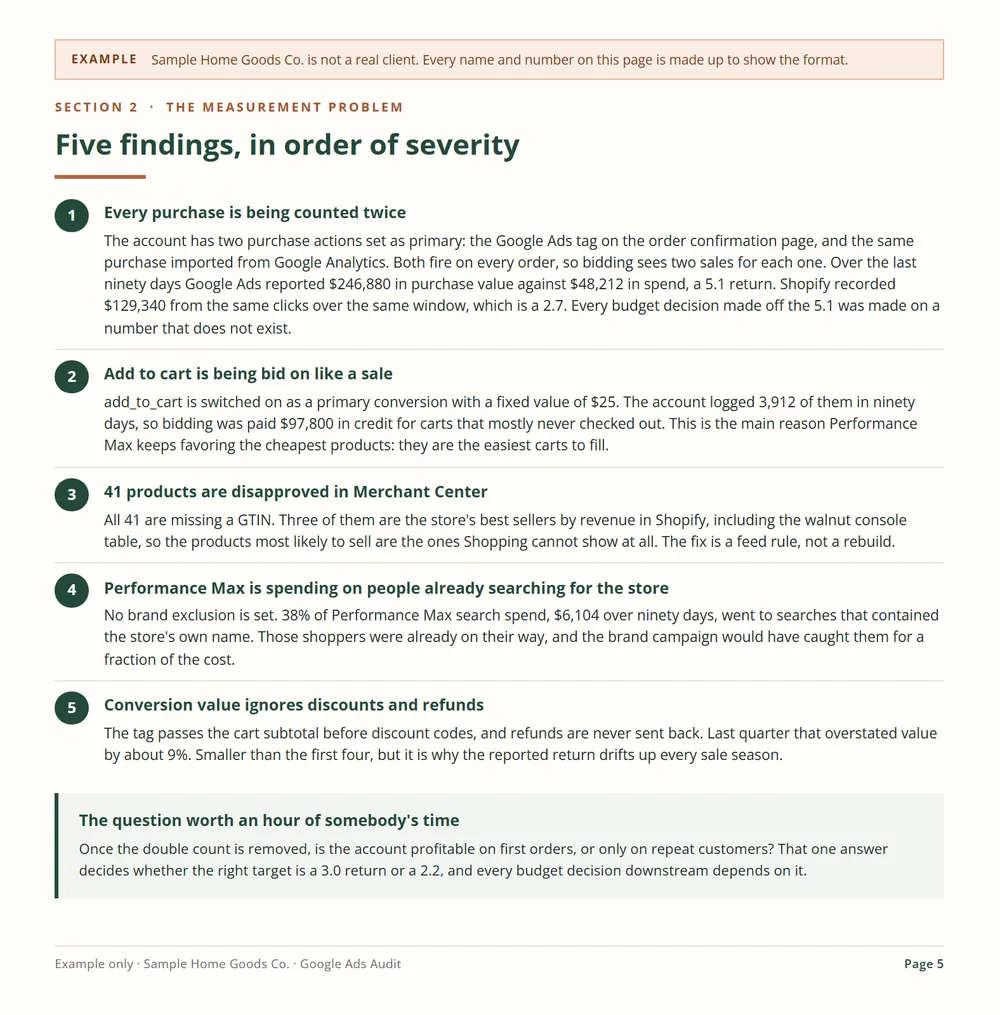
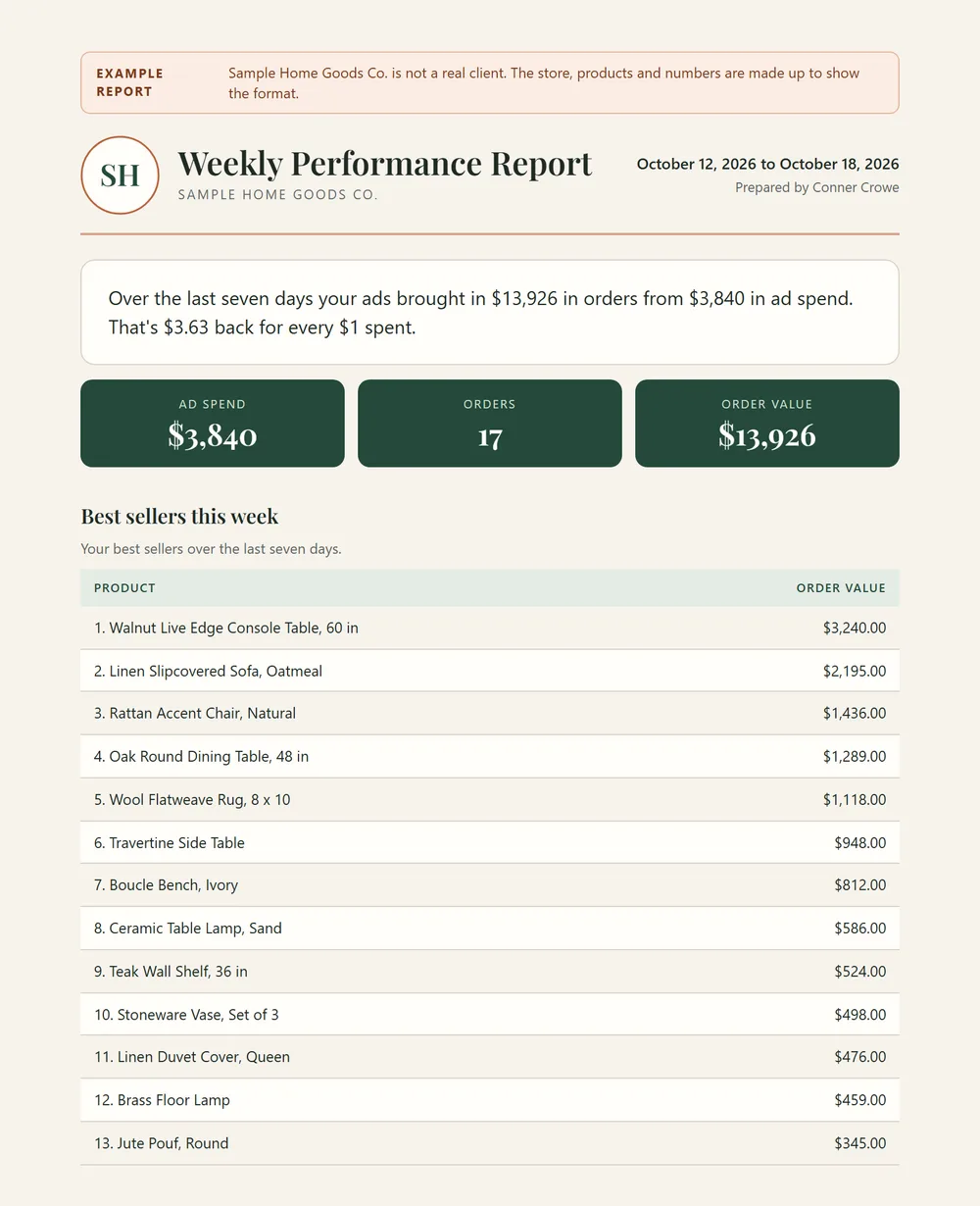
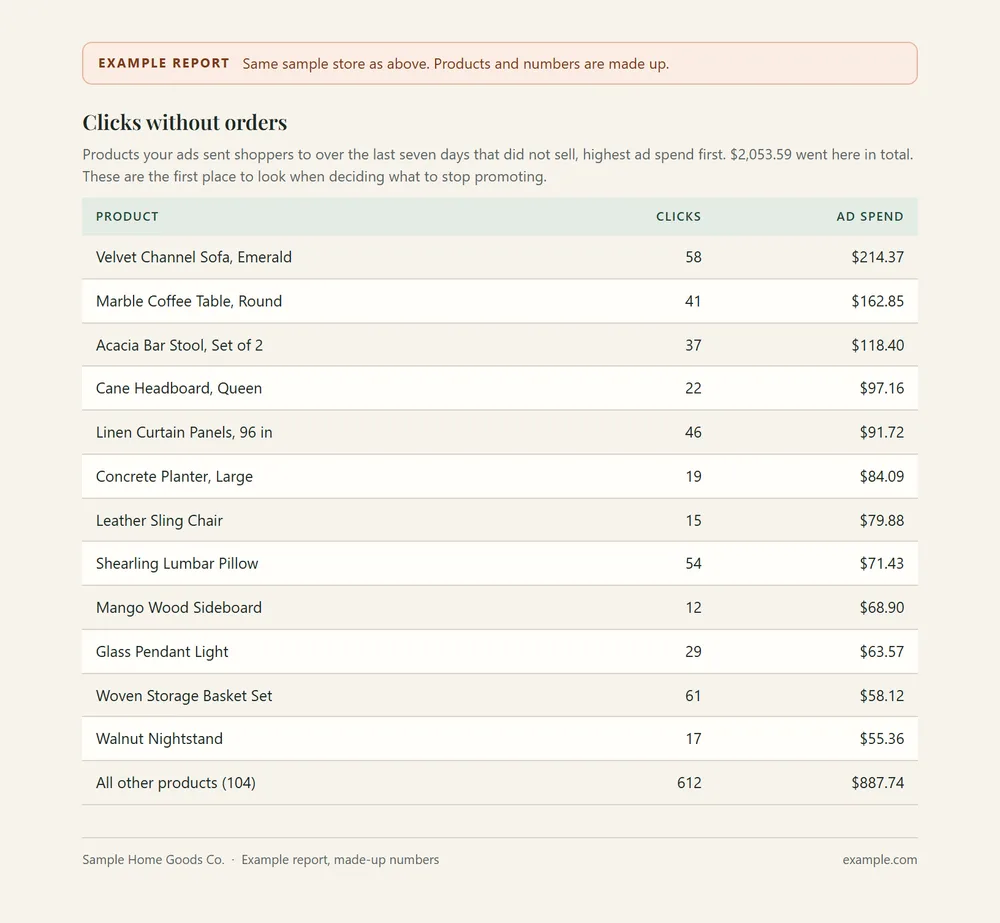
The exact templates I send clients, filled in for a made-up sample store, in the order an engagement runs. Pick a step, or let it play.
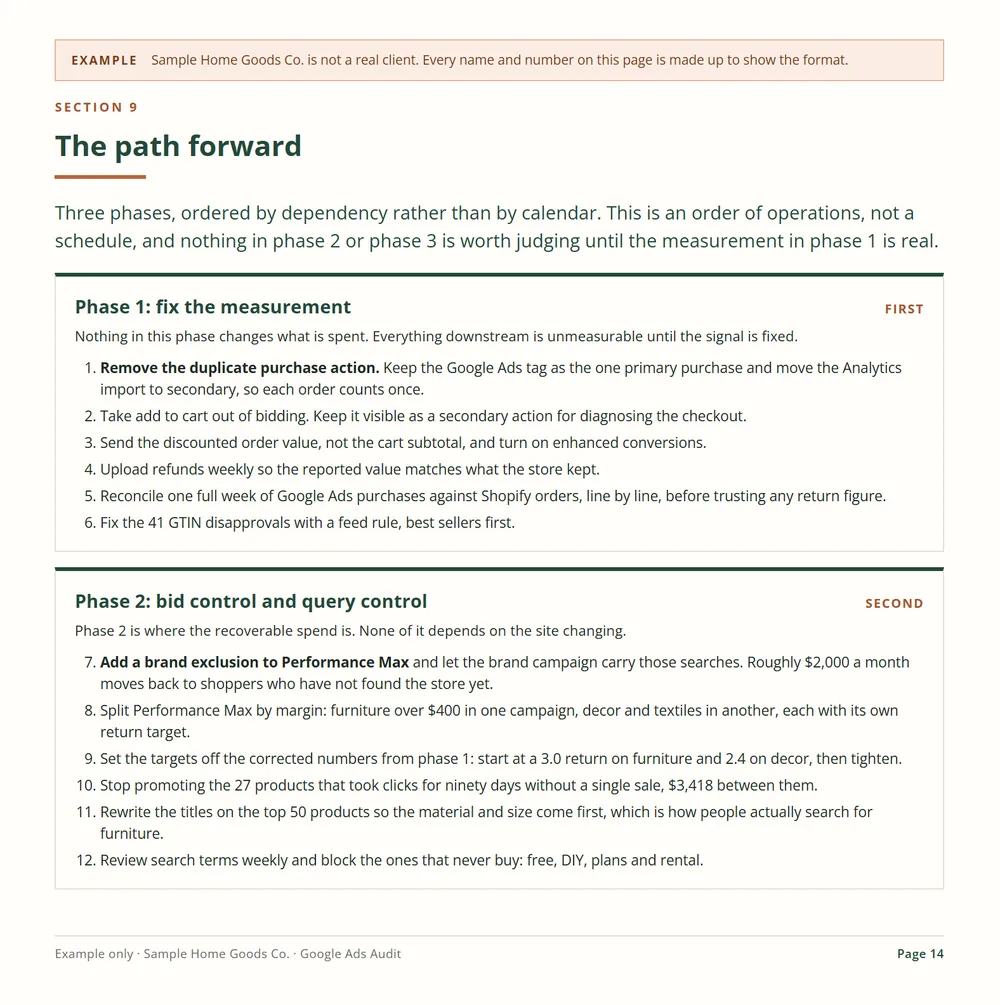 (opens a larger view)
 Week 1
Example page on the real audit template. The store and every number are made up.
05 Inside the imagery engine
Most agencies outsource imagery to a studio and bill it through. Here it's built into the program. What follows is the mechanical exhibit for buyers who want proof under the hood. Skip to the Catalog Lifestyle Gap Audit if you've seen enough. Questions on cost, angles and AI accuracy are answered in my product photography library.
The 5-phase production system
Phases 00 and 03 halt for your approval. Phases 01, 02, and 04 run end-to-end. Nothing ships to your store without you signing off.
Eight anchor images, one per scene template. You approve the set. That set becomes the locked visual contract for every render after.
I read your Shopify catalog via API. Build a structured manifest: handle, title, type, dimensions, materials, scene-template match.
Your brand constitution + the matched scene template + per-product subject block feeds into the image model. PNGs land in staging.
A review batch HTML pairs each staged image with its source product photo. You approve or reject per image, line by line.
Approved scenes push to Shopify via GraphQL productCreateMedia. Appended to the gallery. Never replaces your primary catalog photo.
Brand constitution
A JSON spec I write with you in week one. It defines your brand visually: light, palette, architecture, props rules, composition, atmosphere, forbidden territory. Every batch after week one reuses it.
Every render merges this constitution with a matched scene template and a per-product subject block. The constitution turns the art-direction decisions for 200 SKUs into fixed inputs.
"brand": "Your brand",
"light": {
  "source": "single window natural",
  "kelvin": 3200 to 4200,
  "time": "late afternoon, golden hour",
  "forbidden": ["overhead flat", "strobe"]
},
"palette": {
  "cream": "#f5f0e6",
  "caramel": "#9c7a4e",
  "warm_brown": "#2a1e15",
  "forbidden": ["pure white", "jewel tones"]
},
"architecture": {
  "walls": "aged plaster, matte",
  "floor": "wide-plank aged oak",
  "anchor": "baseboard or doorway always visible"
}
Snapshot from a real brand constitution. Yours will differ. That's the point.
The 99% fidelity engine
Six safeguards. Every batch runs through all six.
Your catalog photos passed as inline image data on every generation call, not just text descriptions.
Per-product list of must-preserve details (hardware, joinery, finish, proportions, edge profile) injected into every prompt.
Width-to-height ratios computed from your dimensions string. Generation rejected if rendered ratio drifts more than 5%.
Every scene contains a known-size element: baseboard at 6 inches, door at 80 inches, window sash at 36 inches. Forces correct scale on the subject.
After generation, a separate model scores the image on FEATURE, PROPORTION, and COLOR each 1 to 10. Below threshold, it auto-retries with corrective notes.
Every approved image carries a content-addressable hash of the exact prompt, brand constitution version, and references that produced it. Audit trail.
Source Rendered
Sixteen products from two real catalogs: Emma Grace Home on Shopify and Vanity Resource on WooCommerce. Each row pairs the catalog product photo I sent the model as the fidelity anchor with the lifestyle scene the model returned. Same piece, every time. The hardware and joinery stay faithful to the source. Read the Emma Grace Home case study or see the live store.


Dark oak media console


Wingback chair, blue velvet


Club chair, antique leather


Arched bookcase, reclaimed pine


Cabinet, glass and panel doors


Armchair, leather and cane


York open-shelf washstand


Tall floor mirror


Swivel chair, white linen


Winfall farmhouse-sink vanity


Media console, washed oak


Arched mirror, hand-carved


Lincoln carved double vanity


Four-drawer chest


Single vanity, cream finish


Salford serpentine chest
Meta Ads method
I start with the catalog and the purchase signal, then build the creative system around how considered home purchases happen. The ads below came from that workflow, for two home brands I run: Emma Grace Home (the furniture catalog above) and Vanity Resource, a reclaimed-wood vanity brand on the same pipeline. Each set was generated and laid out inside the engagement that runs its campaigns.
Feed and signal
Clean catalog fields, Pixel and CAPI agreement, purchase values checked against Shopify, and prospecting separated from retention.
Creative system
Lifestyle scenes built from real product references, then tested by room, product, copy angle, and offer without breaking the visual spine.
Buying-window measurement
I read assisted demand and delayed purchases against blended revenue. A four-figure furniture order rarely behaves like an impulse checkout.
The Emma Grace Home case study shows the catalog and imagery foundation behind this system. It documents the storefront build, not an ad-performance claim.


Ten concepts across two brands. The products and rooms change, but each brand's visual spine stays fixed. I vary the offer and copy to test what moves demand. Once a brand constitution is locked, new ads ship in days. The same operator who renders the imagery sets up the campaigns.
Ship to Google Merchant without flinching
The model layer applies the compliance rules before an image reaches review.
Every PNG carries IptcExt:DigitalSourceType = trainedAlgorithmicMedia, the metadata Google Merchant Center reads to identify AI-generated images.
Watermarking and content provenance baked in by the model, preserved end to end. Not stripped on upload.
Generated alt text discloses the image as AI-rendered. Shopify and Meta both accept this; it protects you on consumer-protection compliance.
Renders push to the gallery only. Your primary catalog photo stays the real product. Lifestyle scenes earn the secondary slots.
Living designer names (the ones at risk in Andersen v. Stability AI) are stripped from prompts before they reach the model. Style without legal exposure.
Auto-rejects faces, hands, text, logos, seals, alcohol, weapons. Catalog-safe by construction.
“I’ve lived many rodeos. This is no noise. Just results.”
06 FAQ
07 Free audit
Drop your Shopify URL. Within 24 hours you get back a 5 to 7 page PDF: image-coverage audit, alt-text gap analysis, your top SKUs ranked by imagery investment, two competitor snapshots, and one sample lifestyle render of your worst-offender SKU done through the production pipeline.
Free. No call required. I read your public store, so there’s nothing to grant. If you want to talk the findings through, a strategy call is open too.
Free catalog audit, written by me
Send the store link and I'll grade the catalog from your public store, back in writing within 24 hours. Nothing to grant, and no call. If you'd rather talk first, a strategy call is open too.