47.66° N 117.43° W Summit · Profitable Growth
00 Process
The Operator Method. How I work with founders.
How the work runs. Every founder I work with goes through the same four stages. Diagnose, scope, ship, compound. Same person on the call as on the keyboard. No account manager filtering the conversation, no deck written by someone who has never seen the account.
Video · 1:03 · Sound on
Who I am and how I work
Read the transcript
I'm Conner Crowe. I help ecommerce and service businesses get more customers from Google, and from AI assistants like ChatGPT. I run the website, the ads and the tracking as one system. Everything between the click and the customer. I started in graphic design, then web design, then in-house marketing, then inside agencies, where I saw the model break. The senior sells the work, and a junior learns on your account. So I went independent. The person on the call does the work. Tracking gets fixed first. You get a written summary every Monday, month to month, and you own everything I build. Ten years, more than $15 million in managed ad spend. A furniture store I built went from $5K in its first month to $56K, five months later. When I'm not working, I'm outdoors. Out there, you never guess when you can measure. I run accounts the same way. Start with a free ads audit. I write it myself, and it's back within 24 hours.
- 4 Stages, in order
- 1 wk From call to written strategy
- Mon Written summary, every week
- 1 Senior on every call
Overview
Four stages, in order. The fourth keeps going.
- 01
WITHIN 24 HOURS OF READ-ONLY ACCESS
Free ads audit
Written by me, 5 to 7 pages, back within 24 hours of read-only access.
- 02
WITHIN ONE WEEK OF THE AUDIT
Strategy + scope
Inside one week, a written strategy you can push back on.
- 03
WEEKS ONE THROUGH THREE OF THE ENGAGEMENT
Rebuild + ship
Tracking goes first.
- 04
Every week, indefinitely · COMPOUNDING
Weekly cadence
Same time every week, just you and me.
01 Free ads audit
Written by me, 5 to 7 pages, back within 24 hours of read-only access.
Within 24 hours of read-only access
You add me as a read-only user, and I read your tracking, your account structure and the last ninety days of performance myself. The audit says what I see, what's leaking, and whether the work makes sense for me to do. If it doesn't, it says that too. If you'd rather talk it through, a strategy call is open.
What you get
- A 5 to 7 page written audit of Google Ads, GA4 and GTM
- An honest read on whether the engagement makes sense
- Two or three concrete fixes you can ship without me
02 Strategy + scope
Inside one week, a written strategy you can push back on.
Within one week of the audit
Inside a week of the audit you get a written strategy, not a deck: the positioning read, what's wrong with the current channel mix, what the tracking has to look like before anything else gets touched, the realistic scaling path over ninety days, and the KPIs I use to know if it's working. You read it, push back where you want, and the scope locks from there.
What you get
- Written strategy document (no decks)
- Tracking rebuild plan
- Ninety-day scaling plan with concrete KPI targets
- Locked scope and weekly working timeline
03 Rebuild + ship
Tracking goes first.
Weeks one through three of the engagement
Tracking gets rebuilt first because nothing else matters if the data is lying. Google Ads conversion imports, GA4 events, GTM containers, server-side where it earns its keep. Then the ads work starts on top of clean data. Strategy work runs in parallel, not after. You are on every key decision in real time, not approving things three days late in a slide deck.
What you get
- Conversion tracking rebuilt end to end
- Campaign restructure with documented rationale
- Weekly Monday written summary, every week
- Direct line for anything time-sensitive
04 Weekly cadence
Same time every week, just you and me.
Every week, indefinitely
Same time every week, just you and me on the call. What changed in the account, what I am testing, what is working, what to kill. Decisions get made on the call, not deferred to a status update a week from now. Between calls you get the Monday written summary so nothing important lives only in memory. The cadence compounds. That is the whole point.
What you get
- Weekly working session on the same calendar slot
- Monday written summary in your inbox by 9am
- Live decisions on the call, not in retrospect
- Quarterly strategic re-plan
The deliverables
What each stage
hands you.
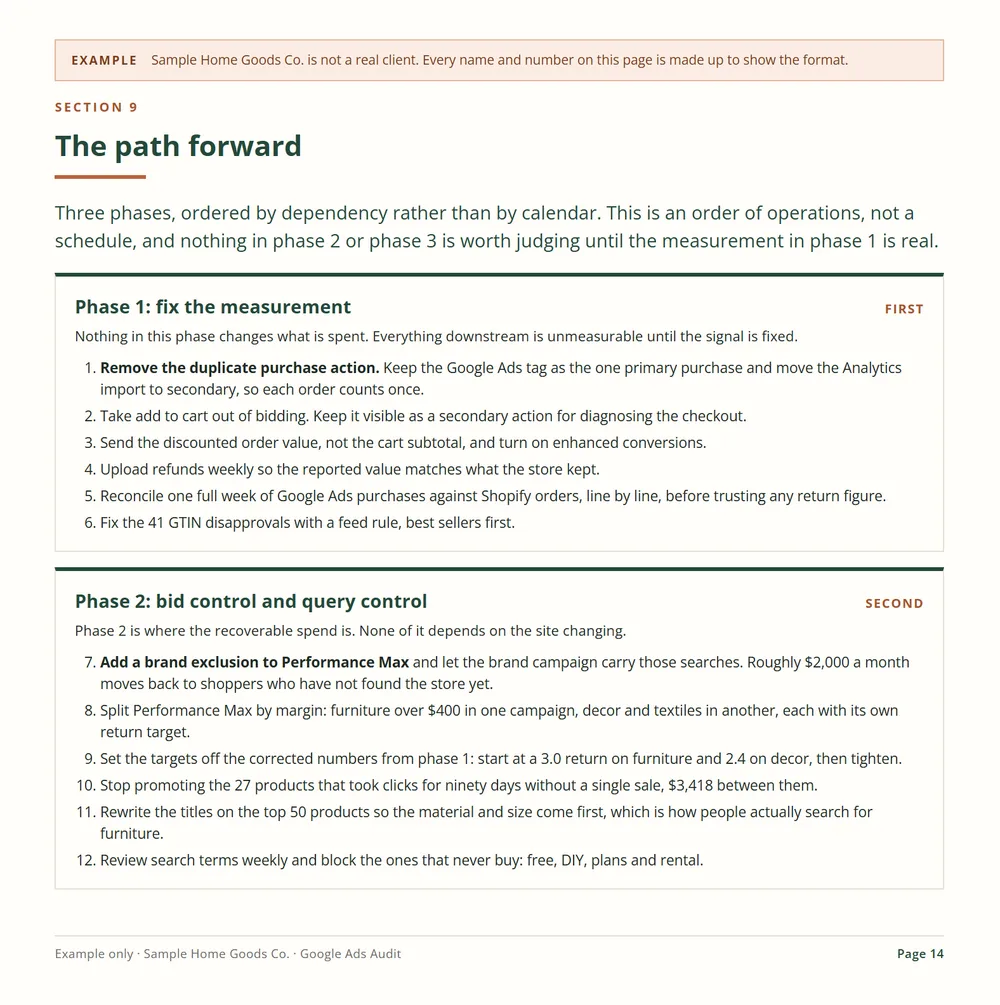
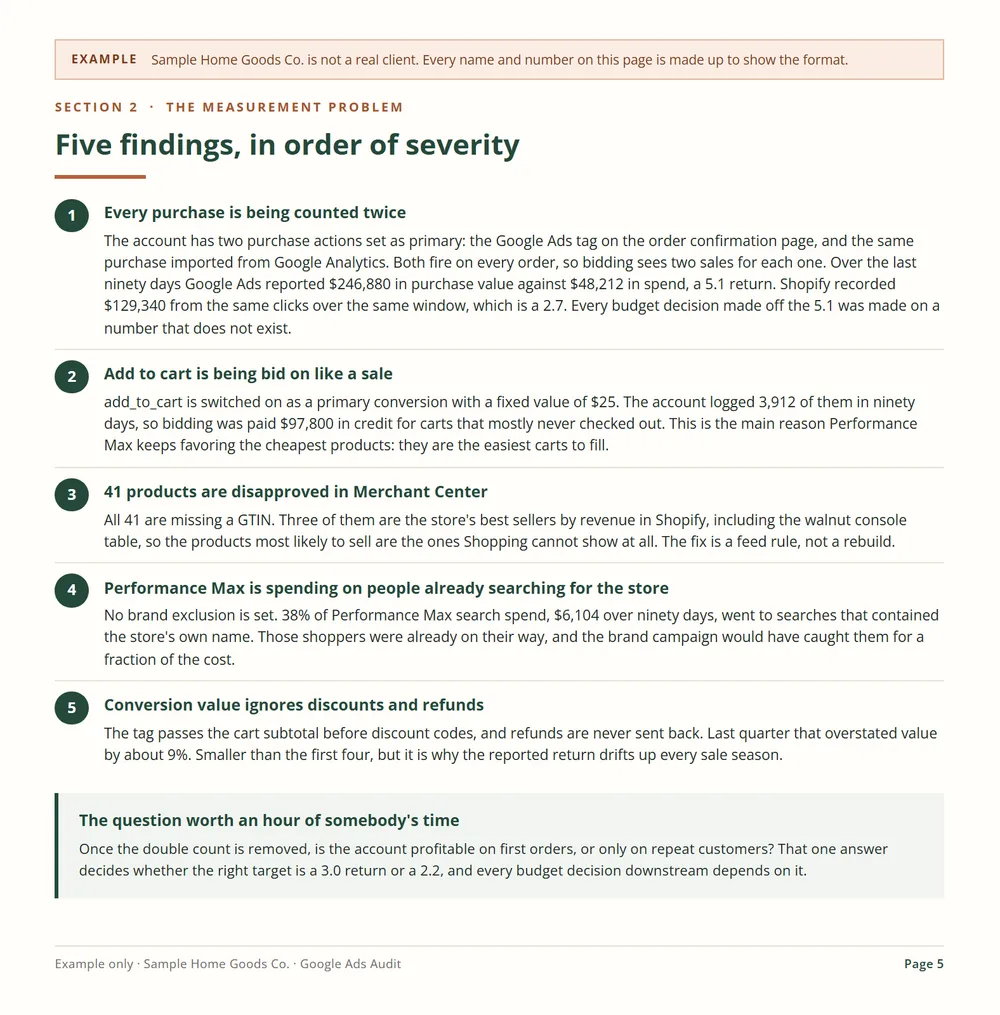
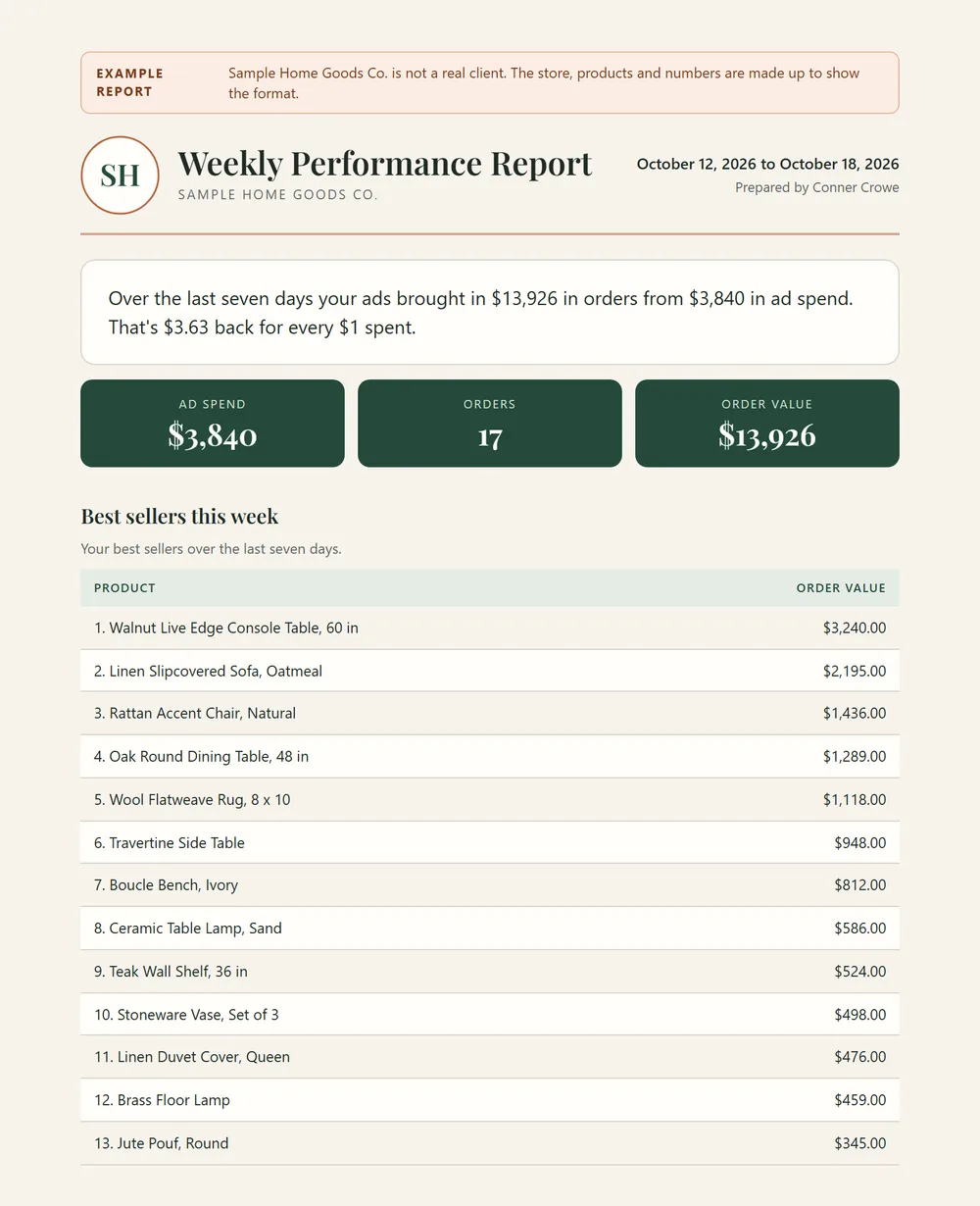
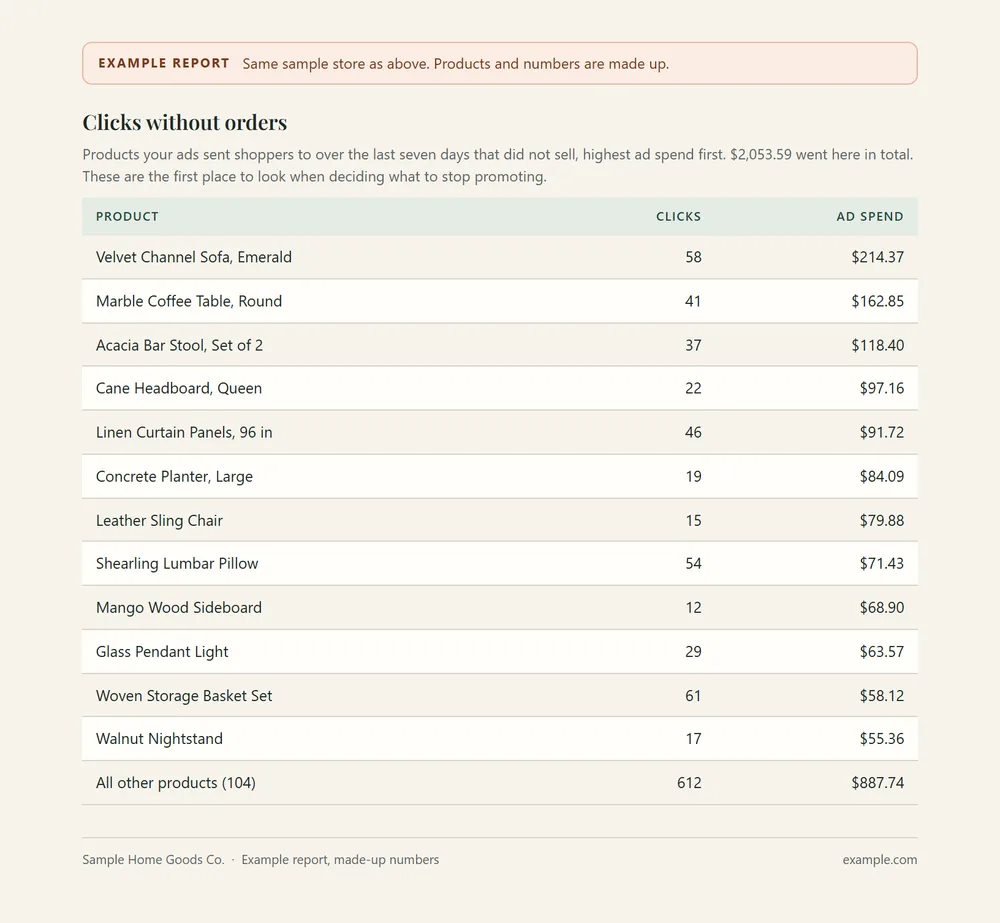
The exact templates I send clients, filled in for a made-up sample store, in the order above. Pick a step, or let it play.
 (opens a larger view)
Week 1
The plan, in writing
- Phases ordered by dependency, not by calendar. Nothing in phase two gets judged until the measurement in phase one is real.
- Written down, so you can push back before a single setting changes.
Example page on the real audit template. The store and every number are made up.
05 What this is not
How this differs
from an agency.
- Not
A slide deck handed off to a junior
IsA written strategy, executed by the same senior who wrote it
- Not
A monthly report you read on a Friday afternoon
IsA weekly Monday summary and a live call where the decisions get made
- Not
A pitched scope that grows quietly each quarter
IsA locked scope, re-planned openly every ninety days
- Not
Tracking left for last because it is hard
IsTracking rebuilt first because nothing else matters without it
Measurement
How I judge
whether it worked.
The method above is what I run. This is the standard the results are held to before any of them reach a page.
Why do GA4 and my ad platform never show the same conversions?
Do you report platform ROAS or real ROAS?
Why fix tracking before optimizing the ads?
What counts as proof of a result before you claim it?
06 Start here
A free written audit.
One clear set of next steps.
Add me as a read-only user and I'll write it myself within 24 hours of access. No call needed.