Most furniture ad budgets get eaten by Performance Max showing dining tables to people shopping for desks. This is how I fix it for $1M to $30M furniture brands.
$24.6K to $116KMonthly store revenue after a bathroom-vanity Shopping rebuild
$5,387 → $56,182Emma Grace Home monthly sales, Apr to Sep 2026
01 The vertical
Why furniture is harder than most ecom verticals.
Furniture brands carry a paid-media problem the rest of DTC ecom does not. Five things stack against the typical $1M to $30M Shopify furniture catalog at once.
01
High AOV, long consideration window
A buyer comparing $2,500 dining tables takes weeks, not minutes. Last-click attribution kills campaigns that would have paid back at day 30. Most furniture accounts run on tracking that cannot see that window. On Emma Grace Home, two competing GA4 installs were filing revenue as Unassigned until I cut one. Read the tracking case.
02
PMax behaves badly on broad categories
Google groups "table" as one intent. Dining tables, desks, side tables, console tables all compete for the same broad signal. Without asset-group splits by room and category, PMax shows the wrong product to the right buyer all day.
03
Lifestyle photography is a structural bottleneck
Studio shoots are billed per SKU and booked weeks out, so new SKUs sit in the warehouse before they reach a feed. Meta catalog ads and Google Shopping both quietly underperform on bare-product imagery.
04
Catalog size makes feed quality non-optional
At 150 to 800 SKUs, sloppy product titles, missing GTINs, and uncategorized custom labels stop being inconveniences. They become the bottleneck on Shopping impression share. Feed quality matters more for furniture than for almost any other ecom vertical.
05
Repeat-purchase economics are weak
A buyer who buys a dining table does not buy a second one next quarter. LTV expansion comes from selling them into the next room, not the next reorder. That means acquisition has to pay back on first purchase or close to it. The margin on prospecting waste is thin.
02 The audit pattern
What I see inside a typical furniture Google Ads account.
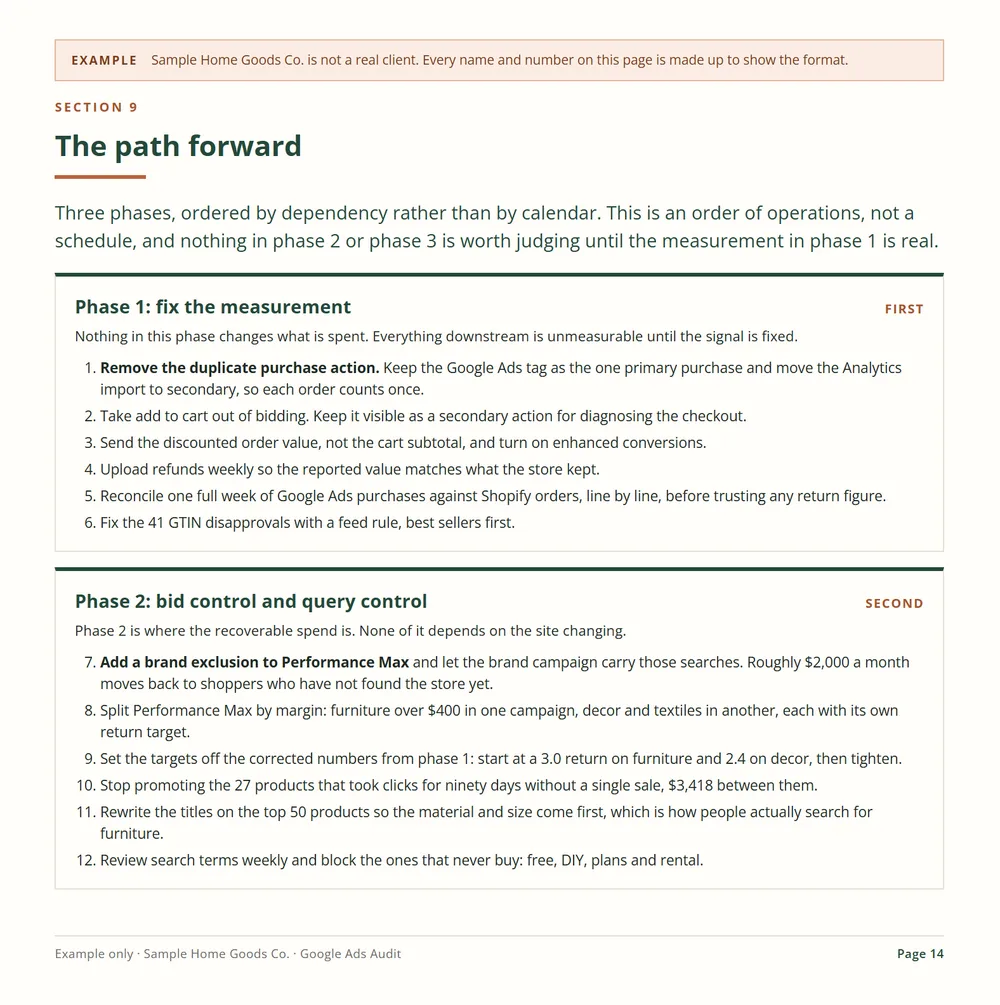
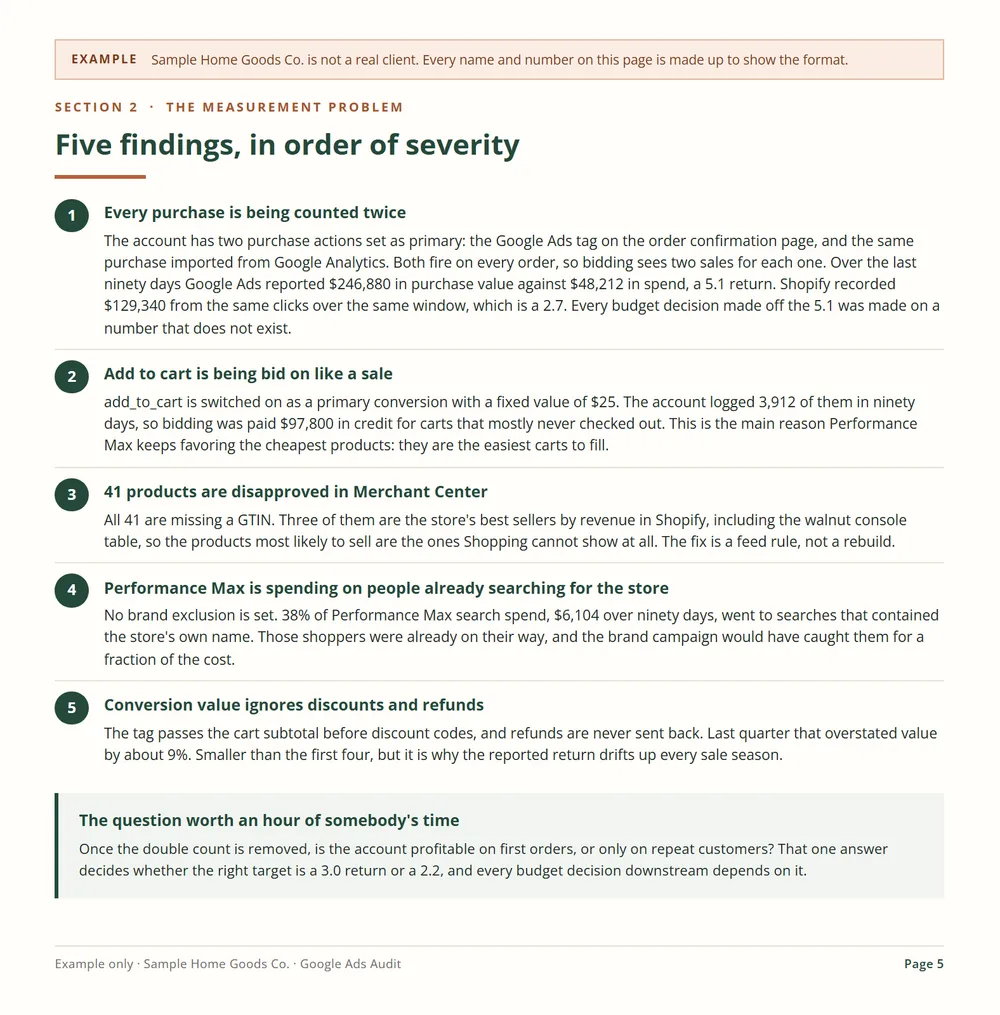
Five patterns repeat across furniture brands at this stage. The list below is the diagnosis log from real audits, scrubbed of names. Hit three of the five and the account is paying for traffic it can't convert before anyone touches creative.
01
PMax bleeding category context
Performance Max shows dining tables to people shopping for desks, side tables to people shopping for nightstands. Without custom labels and asset-group splits by category, the algorithm treats your $1,800 dining set the same as a competitor's $179 console.
02
Feed titles written for humans, not queries
Product titles read like catalog names: a model name and "Wingback." Buyers search "blue velvet wingback chair." Title-query mismatch suppresses impression share on the exact mid-tail queries furniture brands need to own.
03
Missing or invalid GTINs on half the catalog
Custom furniture often ships without manufacturer GTINs and the Shopify product attribute stays blank. Google Merchant suppresses those listings silently. You see the ad spend, you do not see the impressions you should have had.
04
No margin-tier or best-seller custom labels
One bid strategy across a catalog that ranges from $400 mirrors to $5,000 sofas. The high-margin SKUs get the same budget priority as the clearance side tables. Shopping cannot route intent if the feed cannot distinguish products.
05
Bare-product imagery on the PDP
A white-background catalog shot is fine for a search result tile. It is not fine for the product page a $2,500-furniture buyer lands on after the click. No room context, no scale reference, no lifestyle. Conversion rate stays low and nobody can pin down why.
03 The playbook
What I do specifically for furniture brands.
The work order does not change much from account to account. Feed first, segmentation second, imagery third, post-click fourth, brand-isolation fifth, tracking sixth. Six steps that compound.
01
Feed engineering at the source
Shopify product attributes rewritten so titles match real furniture queries: material, style, color, dimension. GTINs filled where they exist, supplemental feed for the gaps. Google product category corrected. The plumbing the campaigns run on.
02
Custom-label segmentation by margin tier
Every SKU tagged by margin tier, best-seller status, seasonal flag, room category. PMax asset groups split along those labels so the algorithm bids the $4,000 sofa differently from the $179 console. High-intent queries route to the high-priority campaign.
03
Lifestyle imagery via the in-house pipeline
Every SKU gets room-context renders through the in-house lifestyle pipeline. Held to a 99% product fidelity bar, audit-trailed. Same plaster-and-oak stage across the catalog so the brand reads as one brand, not eight photographers. Ships to Shopify gallery slots via GraphQL.
04
PDP rebuild for the post-click moment
Gallery sequence rebuilt: catalog hero first, lifestyle scenes second, scale and detail shots third. Specs surfaced above the fold. Trust elements moved out of the footer. The PDP carries its share of the conversion math instead of leaving everything to the ad.
05
Brand kept out of paid
Brand name and misspellings run as phrase negatives on a shared list, and Shopping and PMax carry brand exclusions, so brand searches stop flattering the prospecting numbers. Real cost-per-acquisition on prospecting becomes legible for the first time. Brand gets its own campaign only when a competitor holds the brand search above the organic result.
06
Tracking + ROAS reconciliation
GA4 wired clean, server-side container where it earns its keep, Ads to GA4 reconciliation done weekly. Furniture brands often have long consideration windows. Attribution that respects that window stops killing campaigns that would have paid back at day 30.
04 The proof
Three engagements, three different problems.
One was a Shopping account losing impression share to competitors with cleaner feed data. One was Emma Grace Home, a furniture brand launching 150-plus SKUs without a product photographer. The third is a maker: Robert Russell Designs builds one-of-a-kind tables to commission, and his site has to sell a piece that costs thousands before it exists. All three are real engagements. The first sells bathroom vanities rather than furniture, but the buyer and the feed problem are close. Each is linked below for the full case study.
Case study · Google Shopping, bathroom vanities
Vanity Resource
High-end bathroom vanities, direct to consumer. Shopping was running, but bigger competitors with cleaner feed data were winning impression share on the exact searches the brand needed to own. The fix started with the feed, not the bids.
+38%Impression share
$24.6K to $116KMonthly store revenue after a bathroom-vanity Shopping rebuild
22%Wasted spend recovered
"Wonderful. Explains it thoroughly so I understand. More importantly, seeing great results in such a short time period."
Olivia Streeton, Vanity Resource
A premium furniture store on Shopify I built solo. Sofas, dining tables, vanities, media cabinets, mirrors, lighting at the $999 to $7,500 price band. The brief: ship the storefront in under a month, solo, with the catalog rendered through the in-house lifestyle pipeline instead of a product photographer.
$5,387 to $56,182Monthly store sales, April to September 2026, per the store's Shopify report
150+Products live in catalog
0Product shoots commissioned
0Outside hands on the build
< 1 moKickoff to public launch
No product photographer. No outside designer. No agency PM layer. Kickoff to public launch in under a month.
From the case study
A custom furniture maker in Geneva, Illinois. I rebuilt his site off Weebly with his own photographs in the galleries and the drawing every commission is approved from, then moved his Google Ads onto the new pages the night it went live.
58Pages in the live sitemap
112 of 113Old addresses reaching a live page in one hop or fewer
The same three prices as every brand. Projects get a fixed quote after I have looked at your catalog and feed, and monthly never goes over $8,500.
One-time projects
Fixed price, quoted from the free catalog audit. The smallest valuable thing I can ship is a catalog imagery batch, typically $2,500: ten lifestyle renders of your top furniture SKUs plus one Meta ad set live. A Shopify storefront is usually $5,000 to $20,000.
$2,500 to $20,000
Fixed price, quoted after the audit
Best for
Furniture brands who want to see the work before committing to anything monthly.
Most common
Monthly
$2,500 a month runs the Google Shopping and PMax program for a furniture catalog: feed engineering, custom labels, priority structure. Quarterly imagery batches are an add-on at $1,500 a month.
$2,500 to $8,500/mo
Month-to-month
Best for
Furniture brands launching new SKUs each quarter that already run Google Shopping but lose on imagery and feed quality.
Fractional Marketing Lead
The fractional marketing lead seat for furniture brands, at the top of the monthly range. Strategy, Google, Meta, imagery, tracking, reporting. One operator running the whole program.
$8,500/mo
Month-to-month
Best for
Furniture brands ready to replace the agency model entirely.
Full engagement detail, including the in-house lifestyle photoshoot pipeline that runs inside the retainer, is on the parent home brands page.
What the work looks like
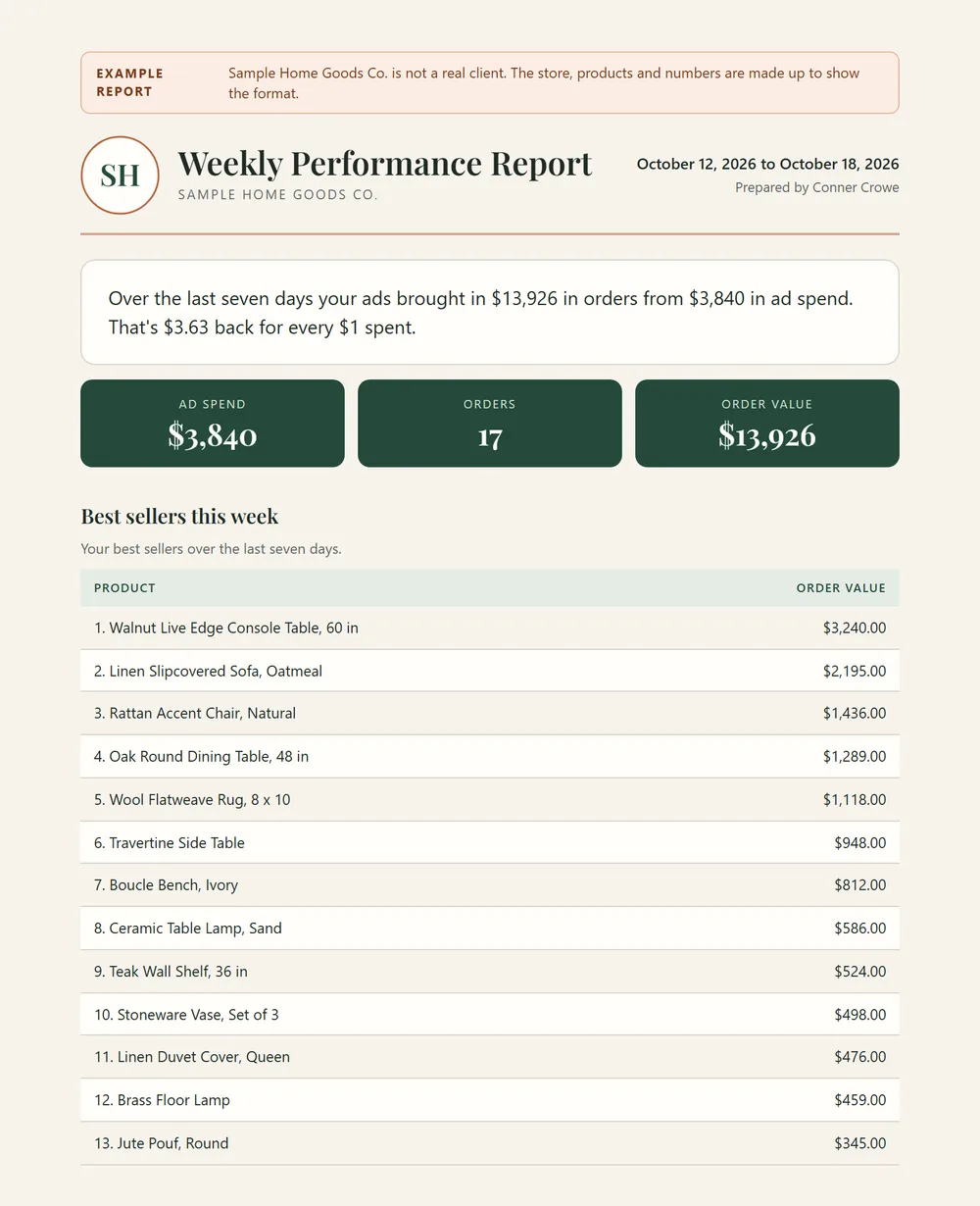
The exact templates I send clients, filled in for a made-up sample store, in the order an engagement runs. Pick a step, or let it play.
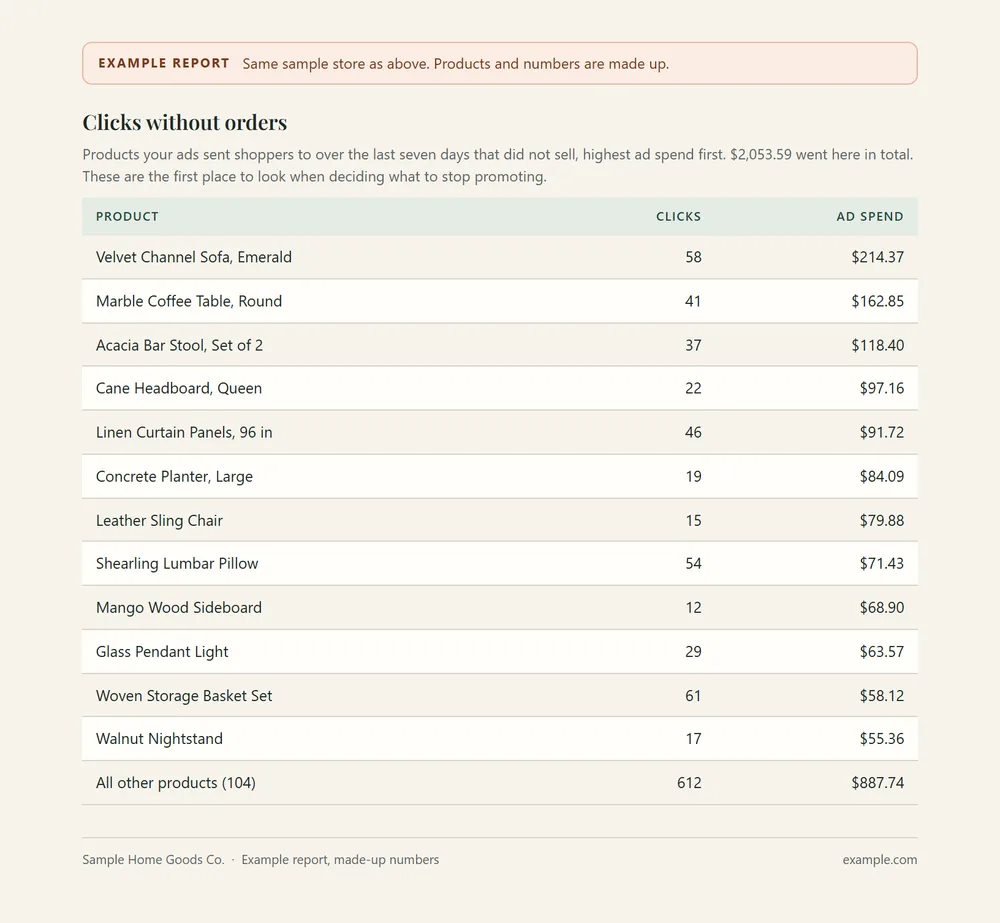
Every product that got clicks and no orders, highest spend first. In this example week it was $2,053.59.
The first place I look when deciding what to stop promoting.
From the same example report. Products and numbers are made up.
06 Fit
Who this is for, and who it is not.
Fits the work
If you are
→$1M to $30M annual revenue on Shopify
→$20K+ per month in paid media spend (Google, Meta, or both)
→Founder-led or marketing-lead-led with budget authority
→Willing to invest in catalog and imagery quality before tactics
→A real product the buyer wants once they see it in a room
Not the right call
Skip if you are
×Pre-revenue or under $1M ARR (you need product-market fit before paid scale)
×Above $100M ARR (you need an agency bench, not one operator)
×Not willing to invest in catalog quality or lifestyle imagery
×Looking for a media buyer to push more budget through a broken feed
×Want a junior to manage the account so you can pay agency rates without the cost
If you book a call
1
Before. I look at your site first, so the call starts on your business, not an intro.
2
The call. Thirty minutes on what’s working, what’s leaking and whether this fits.
3
After. If it isn’t the right fit, you leave with two or three fixes you can ship without me.
★★★★★ 5.0 average from 11 Google reviews.
“I can’t say enough good things about Conner and his work transforming my website and Google Ads strategy!”
Rob Showalter · Owner, Robert Russell Designs · Google review
“Wonderful. Explains it thoroughly so I understand. More importantly, seeing great results in such a short time period.”
Olivia Streeton · Owner, Vanity Resource · Google review
“Conner has been a great partner for GJ Styles. He's smart, responsive, and knows how to turn ideas into action and measurable results. I've lived many rodeos. This is no noise, just results. Highly recommended!”
Doug Diemoz · Former CEO of Crate & Barrel, GJ Styles · Google review
Two ways to start
Start with the audit. No call needed.
The free ads audit is written by me from read-only access to your Google or Meta account: 5 to 7 pages, back within 24 hours of access, no call. The free catalog audit reads your public store instead, so there's nothing to grant.