47.66° N 117.43° W Summit · Profitable Growth
00 The decision library
How to hire a marketer.
You’re paying a retainer and can’t see what it buys, or you’re about to hire and every candidate interviews well. This library covers the decision underneath: which shape of help your business needs, what each one costs, and how to vet whoever you pick. I sell one of the three shapes and I will still tell you when you need a different one.
Want the full solo-versus-agency comparison first? Read the honest version
Video · 0:52 · Sound on
What a fractional marketing lead does, and what it costs
Read the transcript
Hiring senior marketing usually means advice from one person, and the work from someone else. A fractional CMO sets the plan, then hands the work to your team or an agency. I set the strategy, then I run it myself. The Google and Meta ads, the tracking, the landing pages, and a written summary every Monday. Tracking gets fixed first, so the numbers in the report are the numbers in the bank. One store went from $24K a month to $116K. For a law firm, spend was cut in half, and qualified signups doubled. One ad channel is $2,500 a month. The full seat is $8,500. Month to month, no minimum, and you keep everything I build. Start with a free ads audit. I write it myself, and it's back within 24 hours. I'm Conner Crowe.
Last updated October 2026 · 12 answers
01 Start here
Where you are,
and where to start.
Start from the question you already have. Still deciding what shape of help to buy: should I hire a freelancer, an agency, or a fractional marketer? Leaving an agency: what are the best alternatives to a marketing agency? Budgeting the hire: how much does it cost to hire a fractional marketer? Holding a shortlist: what questions should I ask before hiring a marketer? Suspicious of the agency you already have: how do I get an independent second opinion on my Google Ads budget?
Each question below is answered in full, no gate. The honest answer to several of them is "not me": the agency rows I lose are documented on my solo consultant vs agency page, and the freelancer cases are named in the answers themselves. If you want the role itself defined before comparing anything, read what a fractional marketing lead is.
My Q3 2026 benchmark covers the 33 Google Ads accounts I managed in Q3 2026, and my prices and terms are published in full on my pricing page.
02 The six traps
Six ways marketing hires
go wrong.
-
TRAP 01
Hiring channels instead of an owner
A Google Ads freelancer, an email freelancer, and a web developer are three vendors, not a marketing function. Every handoff between them drops information, and the number the founder cares about belongs to nobody. The most common founder setup is also the leakiest one.
-
TRAP 02
Paying senior prices for junior hands
The person on the pitch call is rarely the person in the account. Agency retainers fund the layers between them: account management, coordination, review meetings. Before signing anything, ask for the name of the person who will personally build your campaigns, and how senior they are.
-
TRAP 03
Vetting the deck instead of the work
Portfolios are curated and case studies can be borrowed. Two live accounts with numbers, and an explanation of how each number was measured, beat any presentation. A marketer who cannot produce that within a day of being asked does not have it.
-
TRAP 04
Leaving tracking unowned
Ad platforms optimize against conversion data, and when measurement is nobody’s job, the account learns from wrong numbers for months. Whoever runs your marketing should own the pixel-to-purchase pipeline personally or name exactly who does. "Your developer handles that" is how budgets burn quietly.
-
TRAP 05
Hiring a generalist for a specialist category
A $2,000 average order, a ninety-day consideration cycle, or a 400-SKU catalog each break the standard playbook. If your category has economics like these, demand category proof: a real case with numbers from a business shaped like yours, not a certificate and confidence.
Mine for furniture: the Emma Grace Home store I built solo, 150-plus products at $999 to $7,500 a piece. It's live here.
-
TRAP 06
Contracts that hold your accounts hostage
Ad accounts inside the vendor’s manager account, analytics under their login, tracking in containers you cannot access. The exit terms are part of the hire. If you part ways, every account, every audience, and all the history should stay with you, immediately and without negotiation.
03 The references
Three pages,
no sales call.
-
Solo vs agency, honestly
Including the rows the agency wins.
The comparison founders come looking for: cost per senior hour, who touches the account, where each model breaks, written by someone with a side in the fight who names the bias.
Read the comparison -
The role, defined
What a fractional marketing lead is.
The definition page: how the role differs from a fractional CMO, a freelancer, and an agency, and which businesses the shape fits.
Read the definition -
The proof standard
How I measure results.
The standard every number on this site has to clear before it gets published. Hold any marketer you interview to something like it, including me.
Read the standard
04 The questions
Every question,
answered in full.
Grouped by the decision they belong to. Each question links to a self-contained answer. No gate, no email.
01
One person or a team
4 questions
-
Can one person run Google Ads, email, and a Shopify store's marketing?
Whether one senior marketer can own Google Ads, email, and a Shopify storefront, what the model requires, and where it stops working.
-
Should I hire a freelancer, an agency, or a fractional marketer?
The three shapes of hired marketing help, which one fits which business, and the cost math founders usually run wrong when comparing them.
-
What are the best alternatives to a marketing agency?
Five alternatives to an agency retainer, with sourced 2026 costs, a fit table by situation, and the account-ownership checklist to run before you leave.
-
What happens if my one-person marketer gets sick or quits?
The real risk of hiring one senior person instead of an agency, and five setup rules that make it safe: account ownership, written-down work, a fast handoff.
02
Finding a specialist
3 questions
-
How do I find a marketing consultant for a home or furniture brand?
Where to find a marketing consultant who understands home, furniture, and decor brands, and the category proof to demand before hiring one.
-
How do I hire a marketer for my Shopify store?
What Shopify-specific competence looks like in a marketer, where to find candidates, and the platform gaps that quietly burn ad budgets.
-
What questions should I ask before hiring a marketer?
Seven questions that separate real operators from proposal factories, the answers that should end the interview, and how to check them afterward.
03
Second opinions
3 questions
-
Do I need a new website, or should I fix my ads first?
How to tell whether the site or the ad account is the problem, when to keep the site you just paid for, and why rebuilding an ad account usually costs more.
-
I think my agency is wasting my Google Ads budget. How do I get an independent second opinion?
How to get an independent second opinion on a Google Ads account your agency runs: what independent means, read-only access, and how to vet the auditor.
-
Is Weebly shutting down? Should I move my website off it?
Weebly is winding down in 67 countries, not the US. The dates that matter, what to export before you lose access, and how to move a site without losing the traffic.
04
Cost and pricing
2 questions
-
How much does it cost to hire a fractional marketer?
Sourced 2026 rates for fractional marketing help, what moves the price, published example pricing, and the agency and in-house comparison.
-
Should I pay a marketer a monthly retainer or for a one-time project?
When a marketing problem needs a fixed-price project, when it needs monthly work, and what each price actually covers, from someone who sells both.
05 Where I sit in this
I am one of
the three shapes.
I'm Conner Crowe, a fractional marketing lead. One senior operator holding Google Ads, Meta, email and lifecycle, conversion tracking, and the Shopify storefront for ecommerce and service businesses, with a deep specialty in home and furniture brands. The flagship is Emma Grace Home, a furniture store I built solo on Shopify, and the build is written up here. Ten years in, $15M+ in managed ad spend, and the same person on the Monday call as in the account on Tuesday.
That means this library has a bias, so it's built to be checkable. Every result I claim is documented with numbers in my case studies, the measurement standard behind those numbers is published on my process page, and the pricing is public on my pricing page. Where an agency or a freelancer is the better buy, the answers above say so in plain words.
Use the questions on whoever you hire. If the shape you need is this one, the seven vetting questions apply to me too. Bring them.
What the work looks like
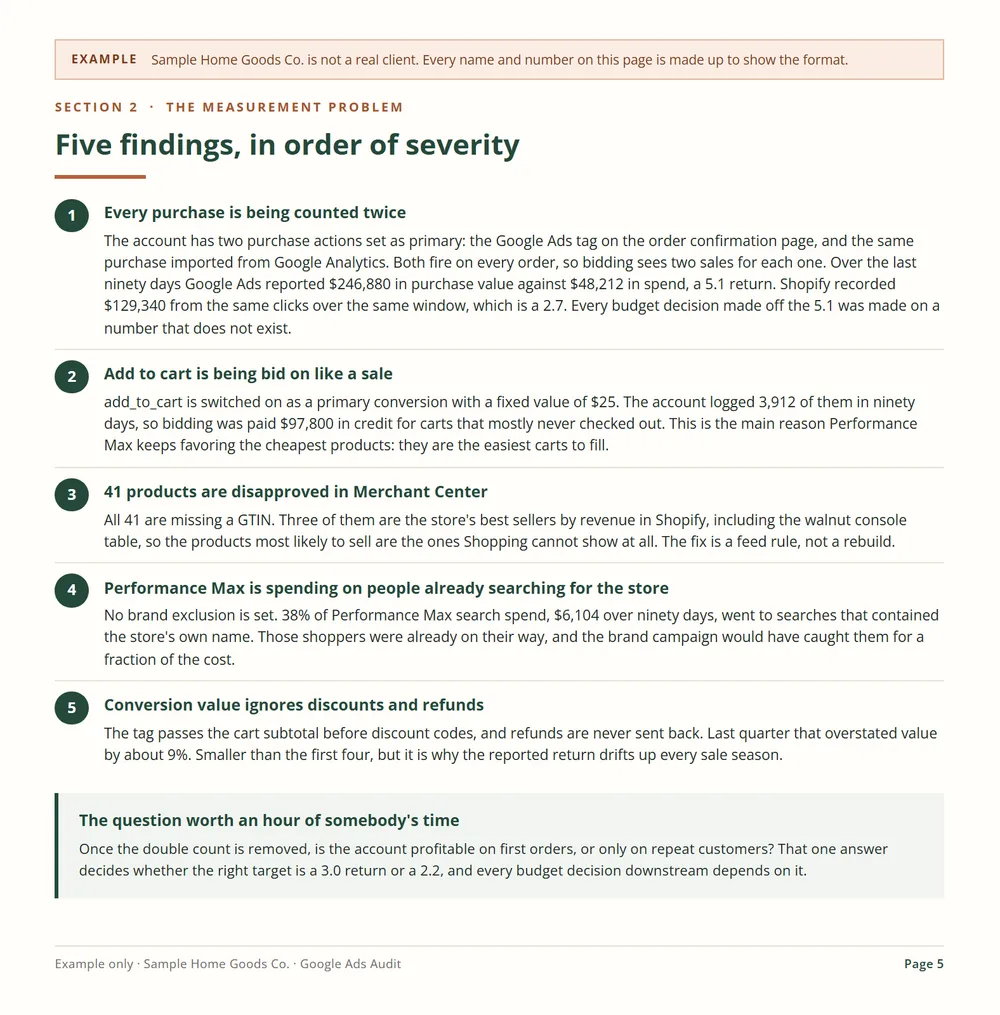
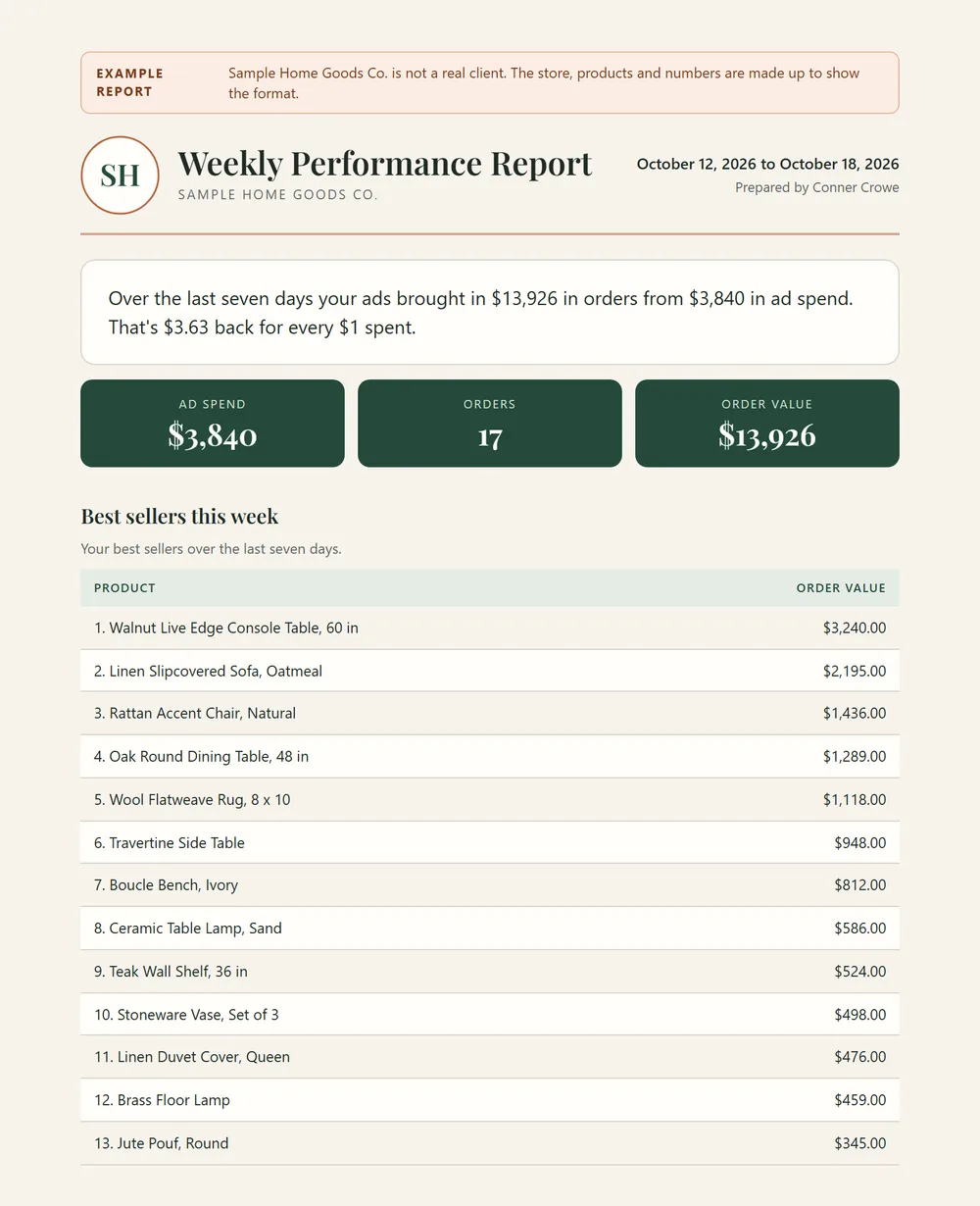
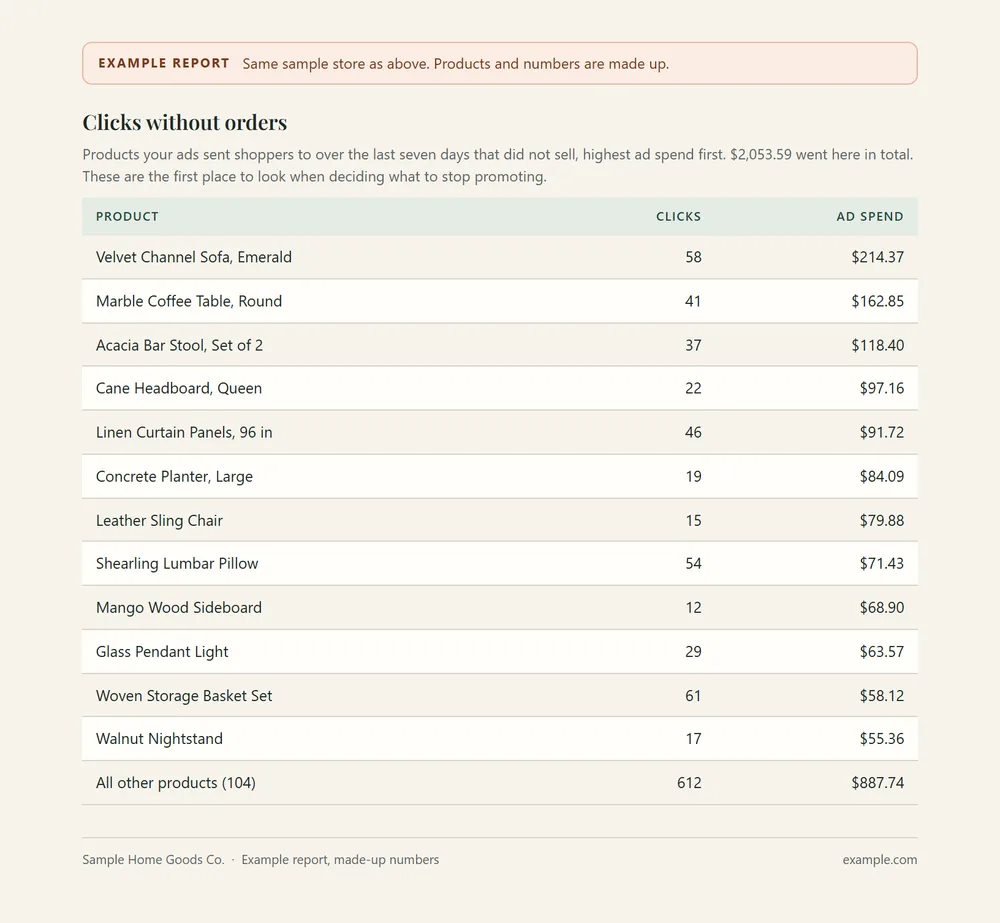
The exact templates I send clients, filled in for a made-up sample store, in the order an engagement runs. Pick a step, or let it play.
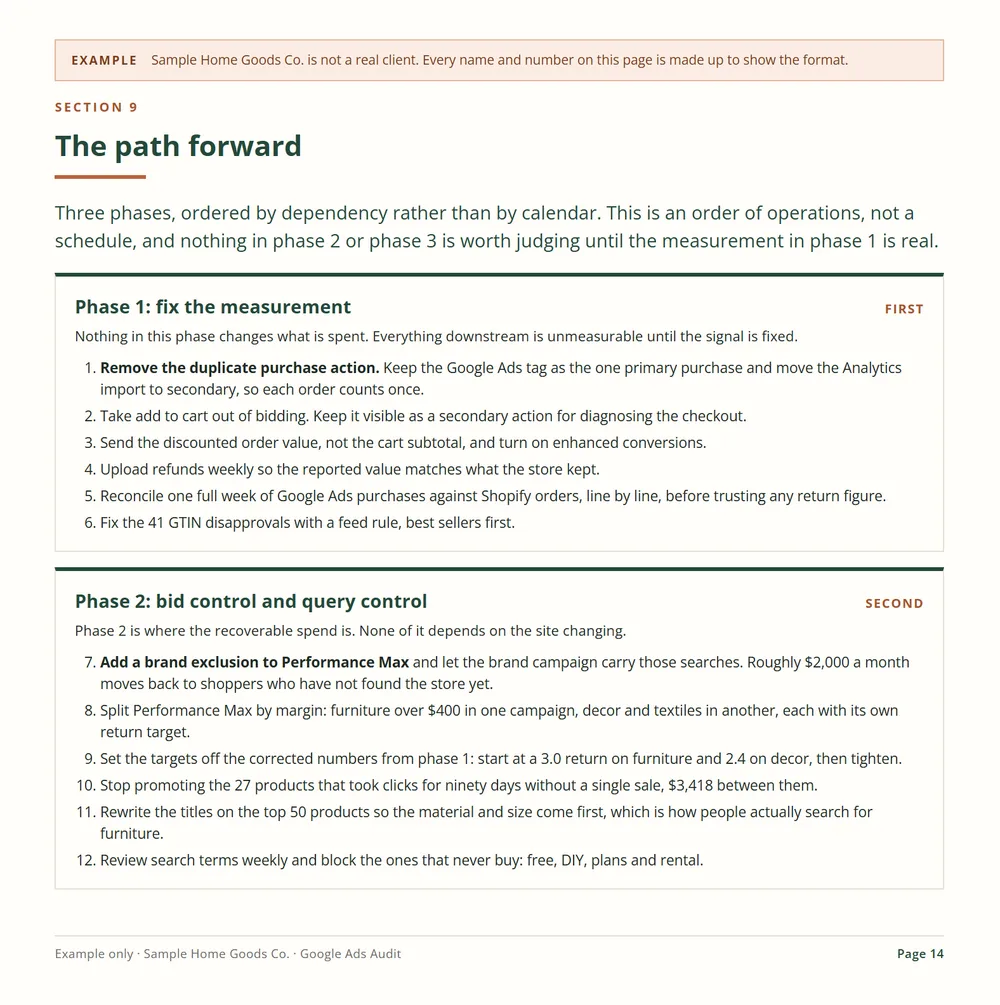 (opens a larger view)
Week 1
The plan, in writing
- Phases ordered by dependency, not by calendar. Nothing in phase two gets judged until the measurement in phase one is real.
- Written down, so you can push back before a single setting changes.
Example page on the real audit template. The store and every number are made up.
If you book a call
-
Before. I look at your site first, so the call starts on your business, not an intro.
-
The call. Thirty minutes on what’s working, what’s leaking and whether this fits.
-
After. If it isn’t the right fit, you leave with two or three fixes you can ship without me.
5.0 average from 11 Google reviews.
Interviewing candidates?
Bring the shortlist.
Leave with a decision.
Add me as a read-only user and I'll write the audit myself: which shape of help the business needs and what it should cost, 5 to 7 pages, back within 24 hours of access. No call needed. If you'd rather talk first, a call is open too.